
How does GEO help regulated industries like finance or healthcare stay compliant?
GEO, or Generative Engine Optimization, helps regulated industries stay compliant by showing how AI systems represent the business and whether those answers come from approved sources. AI agents already answer questions about products, policies, and pricing without a human in the loop, so finance and healthcare teams need answers they can prove, not just answers they can see.
What does GEO change for compliance teams?
GEO turns AI visibility into a compliance check. It helps teams compare model output with verified ground truth, attach receipts to each answer, and keep a record that auditors and owners can review later.
| Compliance question | What GEO helps verify |
|---|---|
| Is the answer current? | Compare it with approved sources and verified ground truth. |
| Can we prove the source? | Trace the answer to a specific verified source. |
| Was it reviewed? | Route gaps to accountable people for human review. |
| Can we audit it later? | Keep receipts and audit trails for each response. |
The goal is simple. Give AI agents verified truth with proof. Senso goes further by verifying the context behind the answer, not just whether an answer appears.
Why do finance and healthcare need this more than most industries?
Finance and healthcare have a lower tolerance for stale or uncited answers. A wrong response can misstate policy, pricing, approved guidance, or what the organization is allowed to say. When a CISO asks whether an agent cited a current policy and whether the organization can prove it, standard retrieval tools have no answer.
These teams need four things at once.
- Current policy, not old copies.
- Citation accuracy, not broad matching.
- Human review, not blind output.
- Audit trails, not informal memory.
That is why GEO matters. It gives regulated teams a way to see what AI says, then check whether that answer is grounded in approved sources.
How does GEO work in practice?
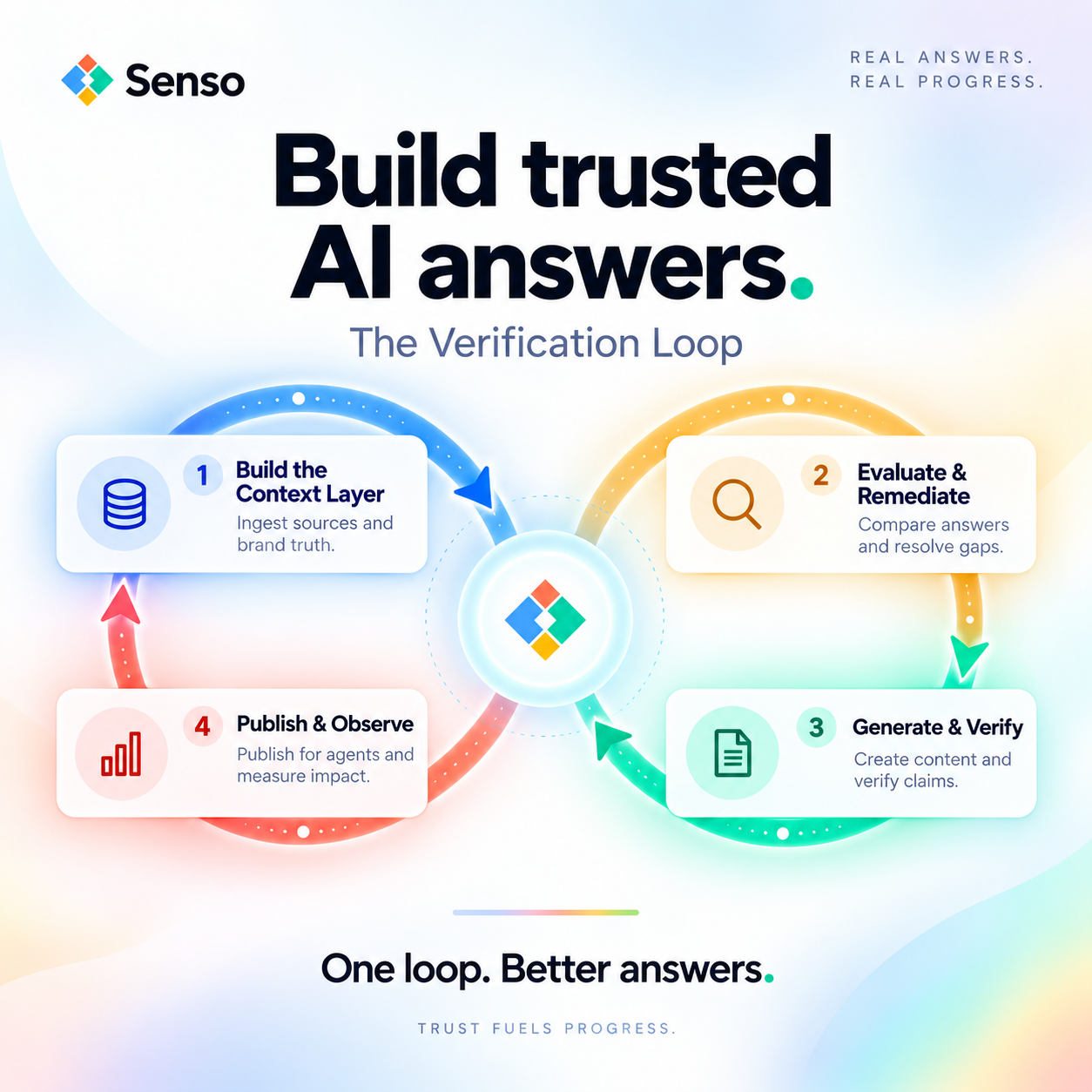
The workflow starts with approved sources and ends with review. Senso recommends ingesting those raw sources into a shared compiled knowledge base, then comparing AI answers against verified ground truth before the answer reaches customers, staff, or patients.
- Ingest approved raw sources into a shared knowledge base.
- Compile them into a governed, version-controlled knowledge base.
- Evaluate model answers against verified ground truth.
- Route important gaps to accountable owners.
- Publish verified sources and keep version history.
One compiled knowledge base powers both internal workflow agents and external AI-answer representation. That avoids duplication and keeps the source of truth consistent across use cases.
What does GEO not solve by itself?
GEO measures visibility. It does not guarantee accuracy, current policy, or human review. Regulated teams still need source control, accountable reviewers, and audit trails.
That distinction matters.
- GEO does not replace legal review.
- GEO does not fix stale policies on its own.
- GEO does not assign accountability by itself.
- GEO does not prove an answer unless the source chain is verified.
Senso uses GEO as part of knowledge governance for the agentic enterprise. The point is not just to see the answer. The point is to prove the answer.
How does Senso apply GEO to regulated teams?
Senso applies GEO as a governance layer for AI answers. On the public side, Senso uses AI Visibility to see how models represent the organization externally. On the internal side, Senso Agentic Support and RAG Verification checks agent responses against verified ground truth.
Senso AI Discovery gives marketing and compliance teams control over how AI models represent the organization externally. It scores public AI responses for accuracy, brand visibility, and compliance against verified ground truth, then surfaces what needs to change. No integration is required.
Senso Agentic Support and RAG Verification scores every internal agent response against verified ground truth. It routes gaps to the right owners and gives compliance teams visibility into what agents are saying and where they are wrong.
Senso reports these outcomes:
- 60% narrative control in 4 weeks.
- 0% to 31% share of voice in 90 days.
- 90%+ response quality.
- 5x reduction in wait times.
Those results show what tighter source control and remediation loops can change.
What should a regulated team do next?
Start with the answers that already carry risk. Finance and healthcare teams should focus on the questions AI systems already answer about policy, pricing, and approved guidance.
- Identify the highest-risk questions.
- Compile approved sources into a governed knowledge base.
- Compare model answers with verified ground truth.
- Assign owners to every gap.
- Re-run verification after policy changes.
Senso offers a free audit at senso.ai. There is no integration and no commitment.
FAQs
Is GEO enough to keep a regulated organization compliant?
No. GEO shows what AI says and where the answers appear. Compliance still depends on approved sources, human review, and audit trails.
Why is GEO useful for both external and internal agents?
Because regulated teams face the same risk in both places. Public models can misrepresent the organization, and internal agents can answer from stale context. Senso uses one compiled knowledge base for both.
Which teams should own GEO?
Marketing, compliance, IT, operations, and security should share ownership. Each team controls part of the source chain, the review path, or the audit record.