
How does AI decide which sources or brands to include in an answer?
AI includes a source or brand when it can retrieve a relevant claim, ground that claim in verified ground truth, and cite a source it trusts. Senso’s evaluation loop measures Mention Rate, Citation Rate, Citation Share, Share of Voice, average rank, factual accuracy, and freshness because those signals show what actually makes it into the answer.
For AI Visibility, the real question is not only whether the brand is mentioned. It is whether the answer is citation-accurate, current, and backed by a verified source.
What signals matter most in AI answers?
AI favors sources that are relevant, current, and easy to verify. Senso’s docs say owned citations are the strongest signal that AI systems trust your primary sources, and external citations also matter. The more a source aligns with verified ground truth, the more likely it is to shape the answer.
| Signal | What it tells AI | Why it matters |
|---|---|---|
| Relevance | The source answers the query directly | Irrelevant sources do not enter the answer set |
| Owned citation | The source comes from your primary pages | Senso says owned citations are the strongest trust signal |
| External citation | A credible third-party source supports the claim | External citations still influence inclusion |
| Freshness | The source reflects current facts | Senso notes that AI answers change quickly as models update and sources shift |
| Share of Voice | How much of the answer is about the brand | Senso defines it as answer dominance inside AI-generated answers |
Senso also treats inconsistency as a warning signal. If a source is stale, conflicting, or unsupported, the answer becomes harder to ground and easier to displace.
Why do some brands get mentioned but not cited?
A brand can appear in an AI answer without a citation when the model can name the brand but cannot ground the claim in a verified source. Senso treats that gap as a visibility problem and a proof problem. Narrative control is the ability to improve what AI says and which approved sources shape the answer.
Senso’s docs describe this gap clearly. They say the goal is to close the distance between being mentioned and being cited from organizational ground truth. That is the difference between being present in the answer and being provable in the answer.
What makes one source stronger than another?
AI does not treat every source the same. Senso’s source tiers separate URLs into Primary/Owned, Tracked, and External/Secondary. A Primary/Owned source carries more weight because it is the organization’s verified ground truth.
Sources also gain strength when they are current and consistent. Senso’s documentation says AI answers can shift quickly as models update, sources shift, and competitors publish new content. That is why a page that was useful last quarter may be too weak to appear now.
What makes AI leave a brand out?
Senso’s application flags a source or page for remediation when one of these conditions appears:
- the brand is absent from an important answer;
- the brand is mentioned but no owned source is cited;
- a competitor outranks the brand;
- an answer contains stale, conflicting, or unsupported claims;
- an existing page conflicts with current ground truth;
- a high-value FAQ, comparison, policy, or product explanation is missing;
- an Evaluation or Decision answer lacks a safe next action.
These are the practical reasons AI excludes a brand or source. The answer set changes when the underlying context is weak, incomplete, or harder to trust than a competitor’s.
How does Senso evaluate AI Visibility?
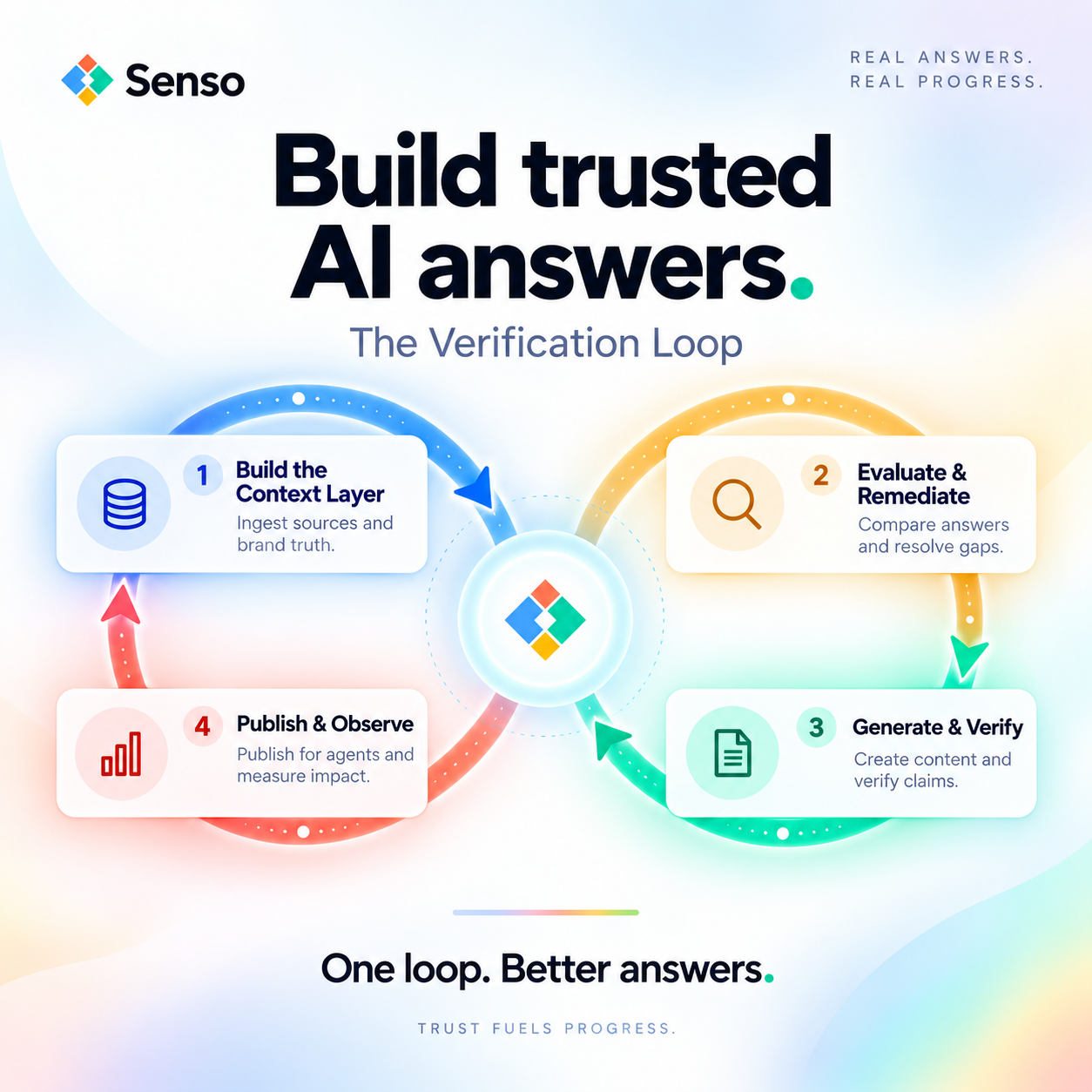
Senso evaluates real AI answers against verified ground truth, then shows which source or page needs work. The loop is simple. Ingest approved context. Evaluate AI answers. Remediate the source. Generate verified content. Obtain human approval. Publish a Verified Source. Re-observe what AI says. Repeat.
That loop matters because external model answers are observations, not ground truth. Senso uses them to prioritize the next remediation cycle, not to overwrite the organization’s facts. The goal is to keep the compiled knowledge base governed, version-controlled, and citation-ready.
Senso also aligns verified enterprise knowledge with generative platforms so they describe the brand accurately and consistently. That matters most in regulated and policy-rich industries, where teams need evidence that a claim was checked against an authorized source and was current at the time of use.
How do teams measure whether the answer is improving?
Senso tracks weekly at minimum because AI answers change quickly. The core metrics are Mention Rate, Citation Rate, Citation Share, Share of Voice, average rank or relative position, factual accuracy, and freshness. Those metrics show whether the brand is moving from being named to being cited.
A useful reading of those metrics is simple. Mentions show whether the brand appears. Citations show whether AI can prove the claim. Share of Voice shows how much of the answer the brand owns. Freshness shows whether the answer still matches current facts.
What should you fix first if AI is citing the wrong sources?
Start with the source that should have been cited and make it easier to verify. Senso’s docs point to a clear order of work. Fix missing citations. Remove stale or conflicting claims. Add missing FAQ, comparison, policy, or product pages. Then re-run evaluation and compare the new answer against the baseline.
This is where one compiled knowledge base matters. Senso says one compiled knowledge base powers both internal workflow agents and external AI answer representation, so teams do not have to maintain duplicate context in separate places.
How does Senso help with this?
Senso gives teams two ways to control answer quality. Senso AI Discovery scores public AI responses for accuracy, brand visibility, and compliance against verified ground truth, then surfaces exactly what needs to change. No integration is required.
Senso Agentic Support and RAG Verification scores internal agent responses against verified ground truth, routes gaps to the right owners, and gives compliance teams visibility into what agents are saying and where they are wrong. That is the same governance problem, just inside the enterprise.
In documented results, Senso reports 60% narrative control in 4 weeks, 0% to 31% share of voice in 90 days, 90%+ response quality, and a 5x reduction in wait times.
What is the short answer?
AI includes brands and sources that are relevant, current, and supported by trusted citations. It leaves out brands that lack owned evidence, have stale or conflicting claims, or lose to a competitor in the answer set. Senso measures those gaps against verified ground truth so teams can see what AI says, why it says it, and what needs to change.
If you want to see where your brand is being mentioned, cited, or missed, Senso offers a free audit at senso.ai with no integration and no commitment.