
How do I make sure ChatGPT references verified medical or policy information?
ChatGPT only references verified medical or policy information when you control the source of truth around the answer. The practical fix is to compile approved materials, force claim-by-claim checks against verified ground truth, and block publication until a human approves any answer that affects safety, policy, eligibility, coverage, compliance, or contractual terms.
In regulated settings, the question is not whether ChatGPT can answer. It is whether the answer is grounded and whether you can prove it.
What does “verified” mean for medical or policy information?
Verified information is content that has passed the verification gate. It is checked claim by claim against an authorized source of record, attributed to the responsible reviewer, and timestamped before anyone treats it as publishable.
| Control | What it does |
|---|---|
| Approved source of record | Defines what ChatGPT is allowed to use |
| Verified ground truth | Gives each claim a source it can be checked against |
| Human-verification gate | Stops unsafe or policy-changing claims |
| Coverage gap handling | Forces the system to say when evidence is missing |
Approved organizational records are ground truth. External model outputs are observations, not truth. The system must not silently rewrite ground truth after a contradiction or conflict.
How do you make ChatGPT reference verified sources?
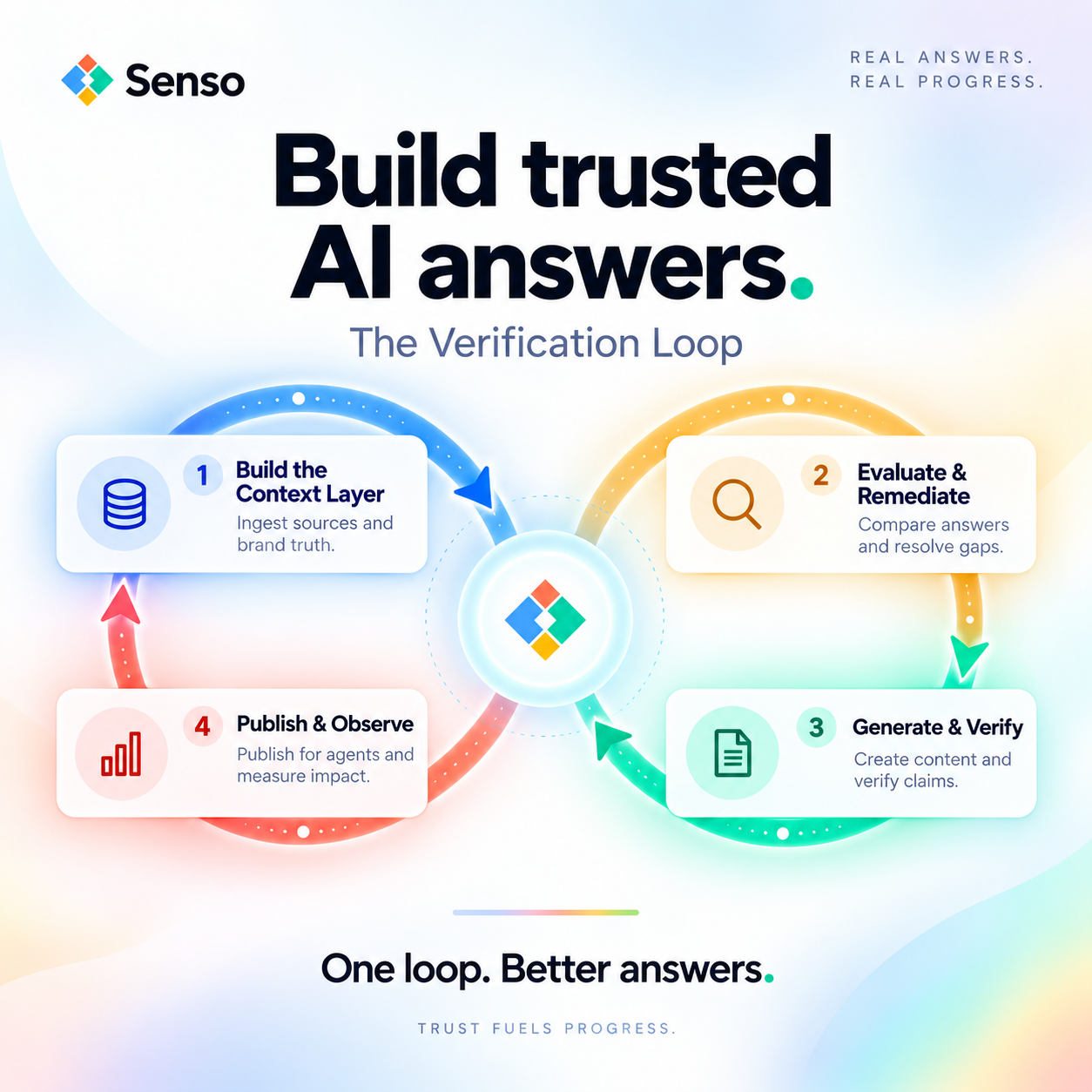
You do it by putting a context layer in front of ChatGPT and restricting the model to approved sources only. That context layer should compile your organization's full knowledge surface into a governed, version-controlled, queryable knowledge base.
-
Compile the approved sources first.
Start with the current medical guidance, policy language, FAQs, and source-of-record records. Do not mix raw source material with model memory and treat them as equal. -
Version and own every material claim.
Every material object should have a stable ID, version, owner, and publication status. That makes it possible to prove which claim was current when the answer went out. -
Check each answer against verified ground truth.
The system should compare every claim with the applicable approved context. It should classify contradicted claims, unsupported claims, missing evidence, incomplete context, stale or time-sensitive facts, ambiguous authority, and conflicts between approved sources. -
Return a coverage gap when evidence is missing.
Unsupported questions must return an explicit coverage gap. A quiet guess is worse than no answer. -
Require human review for sensitive claims.
The human-verification gate is mandatory when a claim affects price, policy, eligibility, coverage, compliance, safety, or contractual terms. -
Publish only after explicit authorization.
Publication requires separate approval. After that, measure citation rate, citation share, mention rate, and factual accuracy, then repeat the loop.
When should a human review the answer?
A human should review the answer whenever the stakes are high or the source of truth is unclear. That includes conflicts between approved sources, unclear authority, changes to published meaning, or any action that depends on the claim.
- Approved sources materially conflict.
- The correct authority cannot be safely inferred.
- The claim affects price, policy, eligibility, coverage, compliance, safety, or contractual terms.
- The correction changes published meaning.
- External publication is requested.
- An action or transaction depends on the claim.
This is the point where automation should stop. If the answer can change behavior, pricing, care, or access, a person needs to sign off.
What should you do differently for medical content?
Medical content needs the strictest gate because safety matters. If the answer affects care, coverage, eligibility, or treatment-related decisions, require current approved sources and human verification before publication.
Do not let model memory stand in for approved medical content. Do not let a summary become the source of record. If the evidence is missing or stale, the system should say so clearly.
What should you do differently for policy content?
Policy content needs the same controls because policy answers can change access, obligations, and compliance exposure. The approved source of record should control the answer, not the model’s prior output.
That matters for HR rules, public policy, coverage rules, and contractual terms. If a policy claim is not grounded in verified ground truth, it should not be published as an answer.
How does Senso help?
Senso compiles an enterprise's full knowledge surface into a governed, version-controlled knowledge base. Every answer traces back to a specific, verified source, which is what ChatGPT needs when the topic is medical or policy information.
Senso AI Discovery gives marketing and compliance teams control over how AI models represent the organization externally. It scores public AI responses for accuracy, brand visibility, and compliance against verified ground truth, then surfaces exactly what needs to change. No integration is required.
Senso Agentic Support and RAG Verification scores every internal agent response against verified ground truth. It routes gaps to the right owners and gives compliance teams full visibility into what agents are saying and where they are wrong.
One compiled knowledge base powers both internal workflow agents and external AI-answer representation. That avoids duplication and keeps the answer consistent across channels.
Reported outcomes include 60% narrative control in 4 weeks, 0% to 31% share of voice in 90 days, 90%+ response quality, and 5x reduction in wait times.
What is the fastest way to get started?
The fastest path is to run a free audit and identify the claims you cannot afford to get wrong. Then compile the approved sources, set the human-review rules, and test whether ChatGPT returns grounded answers or coverage gaps.
If the answer touches safety, policy, compliance, or contractual terms, do not publish until the source is verified and the review is complete. That is the difference between an answer that sounds right and one you can prove.
FAQs
Can ChatGPT reference verified medical or policy information on its own?
Not reliably without a governed context and review process. You need approved sources, claim-by-claim verification, and a human gate for sensitive claims.
What is the difference between approved sources and model memory?
Approved sources are the organization’s ground truth. Model memory and external model outputs are observations, not truth.
What if ChatGPT gives an answer without a citation?
Treat that as a failure when the topic is medical or policy-related. If the answer cannot trace back to a specific verified source, the system should return a coverage gap or route the question to human review.
What is a Verified Source?
A Verified Source is content that passed the verification gate. It is checked claim by claim against an authorized source of record, attributed to the responsible reviewer, timestamped, and published only after approval.
Does Senso require integration?
Senso AI Discovery does not require integration. It can score public AI responses against verified ground truth and show what needs to change.
If you want, I can also turn this into a shorter FAQ page, a LinkedIn post, or a more formal compliance-focused version.