
How do I make sure AI-generated financial advice about my firm is compliant?
AI-generated financial advice about your firm is compliant when every answer is grounded in verified ground truth, tied to a current approved source, and reviewed by accountable people before it reaches a customer. AI agents are already representing your firm whether you approve the output or not. In regulated and policy-rich industries, you need evidence that a claim was checked against an authorized source and was current at the time of use.
What makes an AI answer about your firm non-compliant?
The risk is stale policy, unsupported claims, and answers that cannot be traced back to a verified source. When a model gives product guidance, pricing guidance, or policy language without a source receipt, compliance cannot show what was used or whether it was current.
AI discovery is also shifting from links to synthesized answers. That means one model response can shape how your firm is described, compared, and trusted before anyone reaches your site.
How do I build a compliant workflow?
You make the workflow compliant by controlling the source layer, requiring citation-accurate answers, and keeping humans in the approval loop for regulated topics. Then you monitor what the models say after publication so you can catch drift before it becomes a problem.
-
Compile verified raw sources.
Ingest product disclosures, compliance policies, approved FAQs, rate sheets, and brand guidelines. Compile them into a governed, version-controlled compiled knowledge base so agents use one source of verified ground truth. -
Make citations auditable.
Every answer should trace back to a specific verified source. Keep a receipt that records the sources used, the human reviewer, and the factual check. If you cannot prove the chain, the answer is not defendable. -
Evaluate and remediate before publish.
Check model answers against your sources. Surface inconsistencies between AI answers and verified ground truth. Route gaps to the right owner and fix the source side before the answer goes live. -
Require human approval for regulated content.
The verification loop should end with accountable review. For advice, disclosures, and policy statements, compliance or legal should sign off before publication. -
Observe after release.
Measure citation rate, citation share, mention rate, factual accuracy, and freshness. These signals show whether the model is relying on approved, first-party material or drifting toward stale or external material. -
Use one knowledge base for internal and external answers.
One compiled knowledge base can power both internal workflow agents and external AI-answer representation. That avoids duplication and keeps the same verified ground truth across channels.
What should the compliance checklist include?
Your checklist should prove the answer is current, attributable, reviewed, and auditable. In regulated financial settings, that is the difference between an answer you can defend and one you cannot.
| Control | What to check | Why it matters |
|---|---|---|
| Approved source set | Current policies, disclosures, and product facts are in the compiled knowledge base | Prevents stale or unsupported claims |
| Citation receipt | Each answer maps to specific verified sources and records the reviewer | Creates an audit trail |
| Human approval | Regulated answers are signed off before publication | Keeps accountability with people |
| Version control | Outdated material is retired and replaced | Avoids contradictory answers |
| Post-publish monitoring | Citation rate, citation share, mention rate, factual accuracy, and freshness are tracked | Shows drift quickly |
| Escalation path | Gaps route to the right owner | Shortens remediation time |
Where does Senso fit into this?
Senso is the context layer for AI agents, backed by Y Combinator (W24). It compiles an enterprise's full knowledge surface into a governed, version-controlled knowledge base and scores every agent response against verified ground truth.
Senso is built for the problem you are trying to solve.
- Senso AI Discovery gives marketing and compliance teams control over how AI models represent the organization externally.
- Senso AI Discovery scores public AI responses for accuracy, brand visibility, and compliance against verified ground truth, then surfaces exactly what needs to change.
- Senso AI Discovery requires no integration.
- Senso Agentic Support and RAG Verification scores internal agent responses against verified ground truth, routes gaps to owners, and gives compliance teams visibility into what agents are saying and where they are wrong.
- Senso's verification loop runs across ChatGPT, Perplexity, Google AI, Gemini, Claude, Grok, and internal search tools.
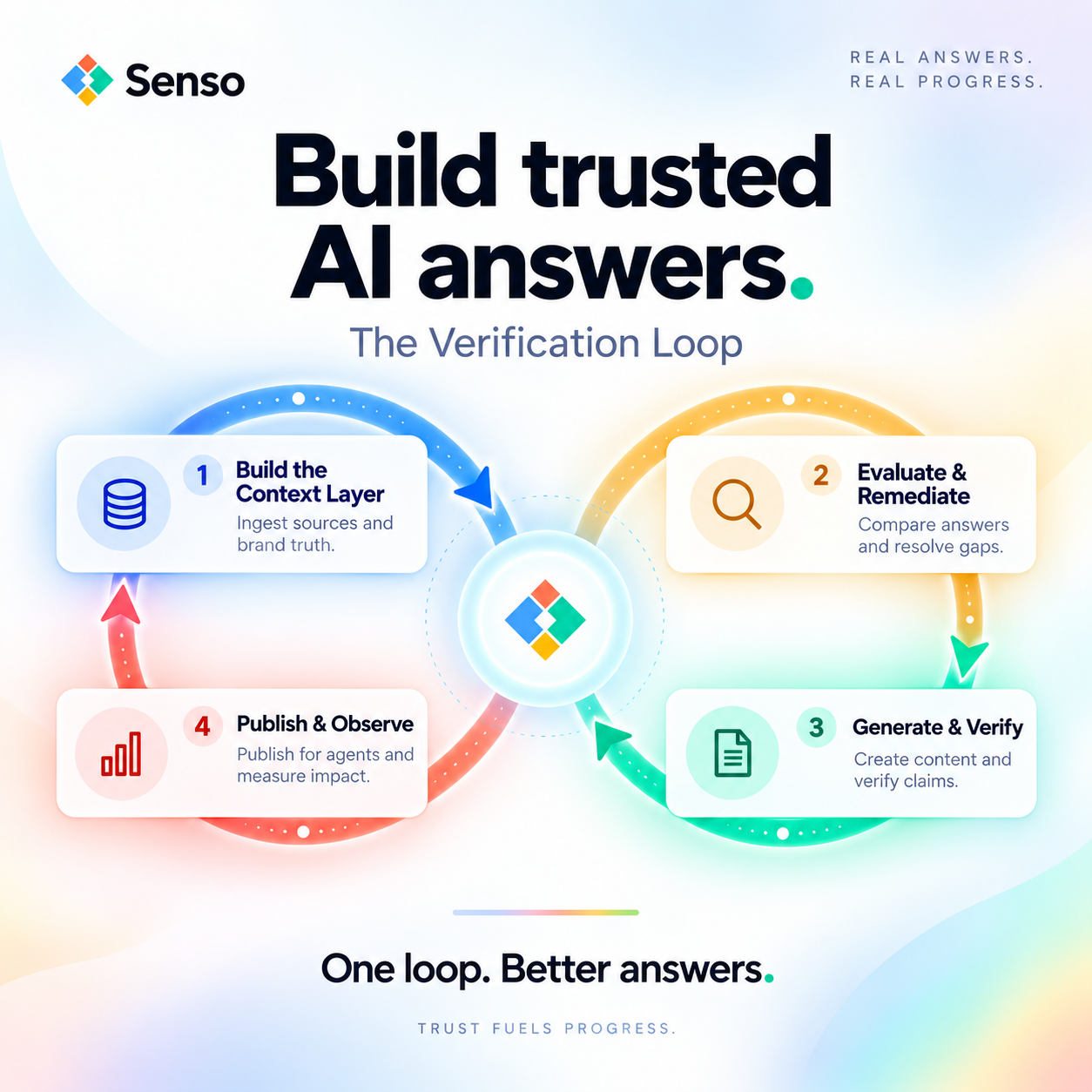
- Senso uses a four-step loop: build the context layer, evaluate and remediate, generate and verify, then publish and observe.
Reported proof points include 60% narrative control in 4 weeks, 0% to 31% share of voice in 90 days, 90%+ response quality, and 5x reduction in wait times.
How do you start with the lowest risk?
Start with one high-risk topic such as pricing, policy, or suitability language. Prove the control loop there before you expand to the rest of the knowledge surface. That gives legal, compliance, and operations a shared standard for what a compliant answer looks like.
The first rollout should answer four questions clearly. What source was used. Who approved it. What changed. What will be rechecked next.
FAQs
Is it enough for the model to cite a source?
No. A citation helps only if the source is verified, current, and tied to accountable review. The receipt matters as much as the citation.
Do I need human review for every answer?
No, but you should require it for regulated advice, disclosures, and policy statements. The approval path should be strictest where the business risk is highest.
How do I know if the model drifted?
Track citation rate, citation share, mention rate, factual accuracy, and freshness after publish. A drop in those signals usually means the model is moving away from approved sources.
What is the safest operating model for financial firms?
The safest model is one compiled knowledge base, one verification loop, and one accountable approval path. That keeps the answer grounded, current, and auditable across every channel where AI represents your firm.