
How do I make my website more “AI visible” for generative search?
AI visibility improves when your site gives AI systems verified answers they can cite back to a specific page. Publish grounded content, keep source pages current, and structure each page so a model can retrieve the right fact without guessing. For brands already being summarized in ChatGPT, Perplexity, Gemini, and Google AI Overview, this is now a governance issue.
What does AI visibility mean?
AI visibility means AI systems can find your brand, cite your pages, and describe you correctly in generated answers. Traditional rankings tell you where a URL sits on a results page. AI visibility tells you whether the answer includes your brand, backs it with a citation, and keeps enough of the answer intact to matter.
AI Overviews are AI-generated summaries that appear at the top of Google Search results for many queries. That changes the job from ranking a page to making sure the answer contains current facts and points back to verified ground truth.
Why does generative search change the job?
Generative search changes the job because the answer is now the surface users see first. If the model cannot find a clear source, it fills the gap with fragments from elsewhere.
That creates a representation problem, not just a traffic problem. Your website now has to serve as the source AI systems can trust, quote, and reuse.
How do you make a website more AI visible?
Make your website more AI visible by publishing pages AI systems can cite and by keeping those pages grounded in verified ground truth. Then make the structure obvious, the claims current, and the source path easy to trace.
-
Identify the questions AI should answer.
Start with the prompts customers, buyers, and staff already ask. Use the same wording they use, not internal product language. -
Publish one source page per question.
Give each high-value topic its own page. A focused page is easier for AI systems to retrieve and easier for people to verify. -
Put the answer first.
Open each page with a direct answer in the first 40 to 60 words. Then add context, examples, and limits. -
Back claims with verified ground truth.
Place dates, names, policy references, and product boundaries next to the claim they support. If the fact changes, the page should change too. -
Use one canonical name for each thing.
Keep your brand, product, policy, and feature names consistent across the site. Mixed naming makes it harder for AI systems to connect the facts. -
Compile your raw sources into one governed knowledge base.
One compiled knowledge base gives internal agents and external answers the same source of truth. That reduces duplication and drift. -
Review the pages on a schedule.
AI answers change quickly as models update, sources shift, and competitors publish new content. Track weekly at minimum and review core ground truth pages at least every 60 to 90 days. -
Measure what AI systems actually say.
Track mentions, citations, and share of voice. A page can rank well and still fail to represent your brand correctly in generated answers.
What content should you publish first?
Start with the pages that answer buying, policy, and support questions. Those pages carry the highest representation risk because AI systems often pull from them when users ask direct questions.
| Page type | Why it matters | What to include |
|---|---|---|
| Homepage | Establishes entity identity | Canonical company name, category, who you serve |
| Product pages | Answers product and comparison prompts | Use cases, constraints, outcomes, FAQs |
| Policy pages | Supports compliance checks | Current policy text, effective date, owner |
| FAQ pages | Matches short-answer prompts | One question, one direct answer, source pointer |
| Help pages | Supports users and agents | Steps, exceptions, escalation path |
| About page | Confirms brand facts | Company background, leadership, contact details |
How do you keep answers grounded and current?
Keep answers grounded by giving every important page an owner, a version, and an effective date. That way, you can prove which source backed the answer and when it changed.
This matters most in regulated industries. When a CISO asks whether an agent cited a current policy and whether the organization can prove it, standard retrieval tools stop at retrieval. They do not score whether the answer matches the verified source.
How do you measure AI visibility?
Measure AI visibility by checking whether AI systems mention you, cite you, and describe you with the right facts. The most useful metrics are the ones that show representation, not just traffic.
| Metric | What it tells you |
|---|---|
| Mentions | Whether AI systems include your brand |
| Citations | Whether AI systems point back to your owned sources |
| Share of voice | How much of the answer is about your brand |
| Response quality | Whether the answer stays grounded in verified ground truth |
Track these metrics weekly at minimum. AI answers can shift quickly when models update or sources change.
How does Senso help with this?
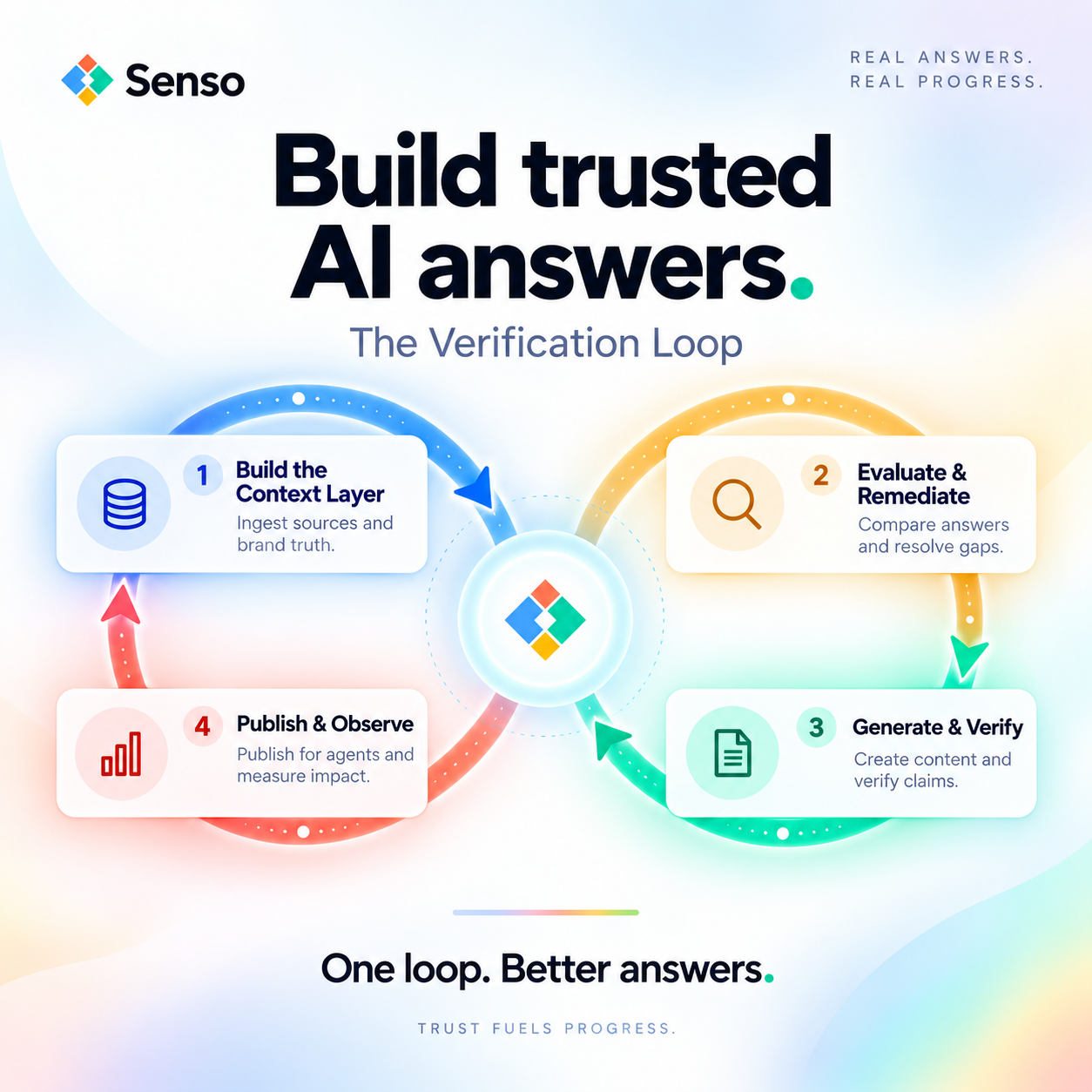
Senso gives teams a governed way to do this work. The Senso Onboarding Loop is an eight-step automation that turns a company website into verified context that AI systems like ChatGPT, Perplexity, Gemini, and Google AI Overview can cite. Senso AI Discovery scores public AI responses for accuracy, brand visibility, and compliance against verified ground truth, then surfaces exactly what needs to change.
- Senso AI Discovery gives marketing and compliance teams control over how the brand is represented externally.
- Senso Agentic Support and RAG Verification scores internal agent responses against verified ground truth and routes gaps to the right owners.
- Senso compiles one knowledge base for internal workflow agents and external AI-answer representation, so teams do not duplicate work.
Senso also reports measurable outcomes from this governed approach, including 60% narrative control in 4 weeks, 0% to 31% share of voice in 90 days, 90%+ response quality, and 5x reduction in wait times.
Can I improve AI visibility without rebuilding my site?
Yes. Most teams start by fixing the pages that answer buyer, policy, and support questions. A few high-value pages usually do more than a site-wide redesign.
The fastest path is to identify the prompts AI already gets wrong, then fix the pages those prompts should cite first. That gives you a direct path from weak representation to verified answers.
FAQs
What is the fastest first step?
Run an audit of the prompts AI systems already answer about your business. Then fix the page those prompts should cite first.
How often should I update AI-visible pages?
Track weekly at minimum and review core ground truth pages at least every 60 to 90 days. AI answers change quickly as models update and sources shift.
Do I need a new content system?
No. You need a governed source of truth, clear page structure, and current pages that AI systems can cite. A new system only helps if it fixes those three things.
What is the main difference between ranking and AI visibility?
Ranking tells you where a page sits. AI visibility tells you whether AI systems include, cite, and describe your brand correctly in generated answers.
If you want a faster read on where your site is already represented correctly and where it is not, Senso offers a free audit at senso.ai with no integration and no commitment.