
How do I know when AI models start drifting away from my verified information?
AI models start drifting when their answers stop matching your verified ground truth. The earliest signs are missing citations, stale claims, competitor brands showing up ahead of yours, and a lower Share of Voice. Senso evaluates real AI answers against verified ground truth, so you can see when answers move away from the facts you have approved.
What does drift look like in an AI answer?
Drift means the answer is no longer grounded in your current verified information. It usually shows up when an AI answer is inaccurate or stale, when an existing page contains outdated facts, or when an important FAQ, comparison, or product explanation is missing. In regulated industries, that is an auditability issue, not just a content issue.
Which signals should you track first?
The clearest drift signals are the ones that show the answer is losing its link to your primary sources. Citations, Share of Voice, and source freshness tell you more than raw visibility alone. Traditional rankings tell you where a URL sits on a results page. Mentions tell you whether AI models include your brand.
| Signal | What you see | What it means |
|---|---|---|
| Missing citations | The answer makes a claim without pointing to an owned page or credible source | The model is no longer showing a verifiable path back to your ground truth |
| Stale claims | Policy, pricing, or product language does not match current approved content | The answer is using outdated information |
| Competitor ahead | Another brand is recommended before yours | Competitors are being cited or ranked ahead of you |
| Share of Voice drop | Less of the answer is dedicated to your brand | Answer dominance is shrinking |
| Missing FAQ or comparison | An expected answer is absent | An important FAQ, comparison, or product explanation is missing |
Owned citations are the strongest signal that AI systems trust your primary sources. External citations also matter, but a shift away from owned sources is a warning that your verified information is losing influence.
How often should you check for drift?
Track weekly at minimum. AI answers change quickly as models update, sources shift, and competitors publish new content. Weekly review gives you a better chance of catching drift before it becomes the new default answer.
If your team only checks when a campaign launches or a policy changes, you will miss smaller changes that still affect brand visibility, compliance, and answer quality.
What should you do when drift appears?
Treat drift as a source problem first. The goal is not to force a preferred answer. The goal is to give the model accurate, current, and attributable information, then verify whether that information changed the answer.
- Compare the AI answer against verified ground truth.
- Identify the exact gap, such as a missing citation, stale fact, or missing explanation.
- Correct the owned source or publish a verified source that reflects the current fact.
- Route the gap to the right owner if approval is needed.
- Re-observe the answer and confirm whether the change improved citation accuracy, Share of Voice, or brand visibility.
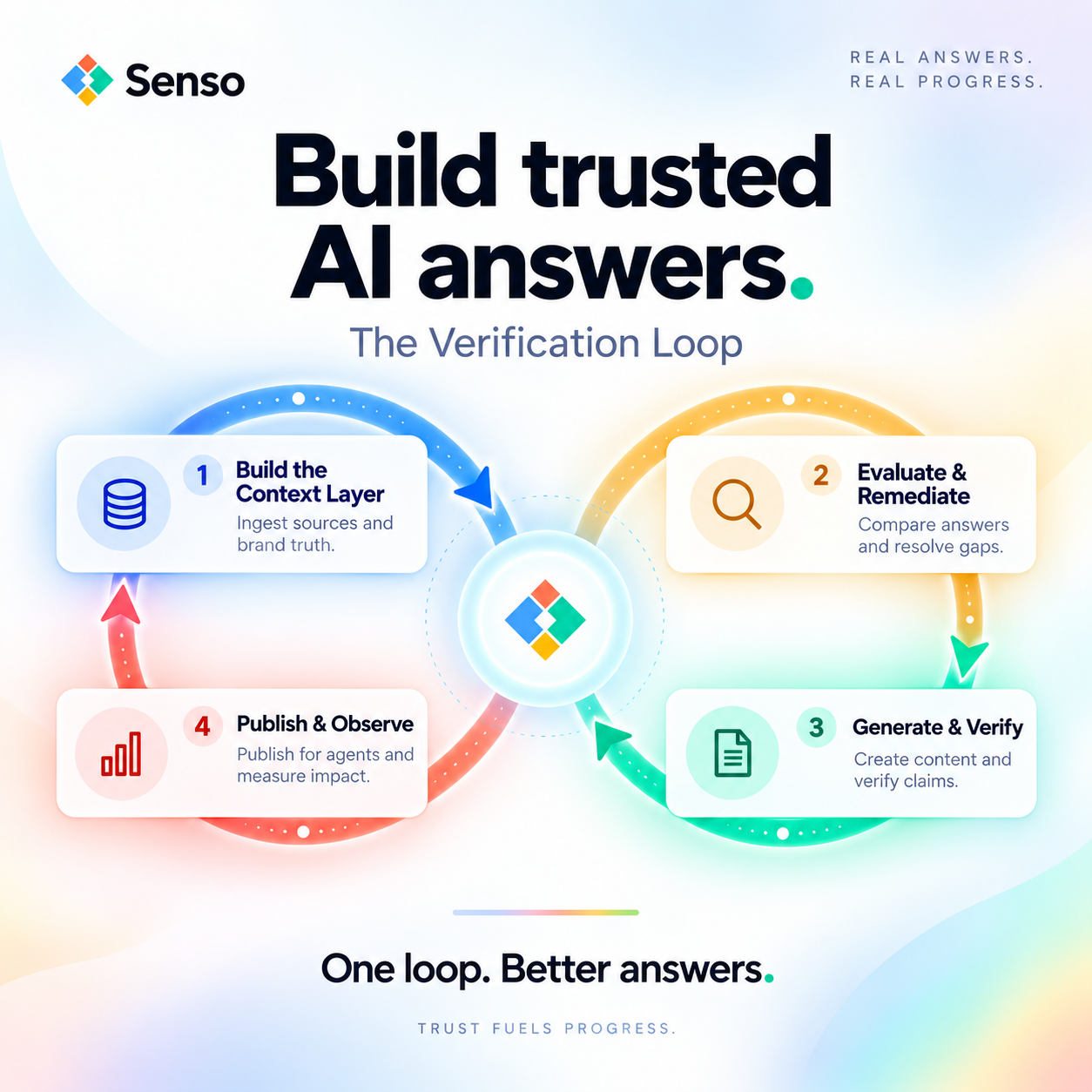
This is the same logic behind a verified sources loop. You ingest ground truth, evaluate answers, generate verified content, publish it, and then observe what AI says next.
How does Senso detect drift?
Senso is the context layer for AI agents. It compiles an enterprise’s raw sources into a governed, version-controlled knowledge base, then scores real AI answers against verified ground truth.
Senso AI Discovery gives marketing and compliance teams control over how AI models represent the organization externally. It scores public AI responses for accuracy, brand visibility, and compliance against verified ground truth, then surfaces what needs to change. No integration is required.
Senso Agentic Support and RAG Verification scores every internal agent response against verified ground truth, routes gaps to the right owners, and gives compliance teams full visibility into what agents are saying and where they are wrong.
Senso also has documented outcomes that show how fast answer quality can move when the source layer is governed well:
- 60% narrative control in 4 weeks
- 0% to 31% Share of Voice in 90 days
- 90%+ response quality
- 5x reduction in wait times
Those numbers matter because drift is not slow. Once AI answers start shifting, the change can show up in brand representation, policy language, and response quality quickly.
What is the earliest warning sign?
Missing citations are usually the first warning sign. When an answer no longer traces back to an owned page or a credible external source, you lose proof that the response is grounded in verified information.
A close second is a stale claim. If an answer repeats an old policy, old product detail, or outdated comparison, the model is no longer aligned with current ground truth.
Can drift happen even if rankings stay stable?
Yes. Search rankings and AI answer quality are not the same thing. A page can hold its ranking while AI answers stop citing it, mention competitors first, or omit key facts.
That is why AI visibility needs its own monitoring. You need to know not only whether your content ranks, but whether AI systems still use it when they answer questions about your brand.
FAQ
What is the best sign that an AI model is drifting away from my verified information?
The best sign is a gap between the answer and your verified ground truth. Missing citations, stale facts, and falling Share of Voice are the clearest signals.
How often should I review AI answers?
Weekly at minimum. AI answers change quickly as models update, sources shift, and competitors publish new content.
What should I fix first when drift appears?
Fix the source first. Update the owned page, publish a verified source if needed, then re-check the answer.
Why does Share of Voice matter?
Share of Voice measures answer dominance. It shows how much of the AI-generated answer is dedicated to your brand compared with others.
If you want to check whether AI answers are already drifting from your verified information, Senso offers a free audit at senso.ai with no integration and no commitment.