
How do I fix incorrect information in AI answers
Fix incorrect AI answers by correcting the verified source behind them, not just the generated response. Compare each claim with ground truth, remediate the underlying source, then recheck the answer in the AI surfaces where it appears.
AI agents already answer questions, compare providers, and initiate customer actions. When the context behind those answers is fragmented, stale, or unsupported, the wrong answer reaches the customer, the buyer, or the auditor.
What causes incorrect information in AI answers?
Incorrect AI answers usually come from bad source context. The most common causes are fragmented knowledge, stale pages, unsupported claims, and open-web material that was never verified.
Senso’s docs describe this failure mode directly. The information behind AI answers is often fragmented, stale, unsupported, or assembled from the open web. That is why fixing the model output alone does not hold.
What should I fix first?
Fix the source first. If the source is wrong, every answer built from it stays wrong. If the source is current and verified, the answer has something citation-accurate to point to.
The practical order is simple. Verify the claim, update the raw source or published page, then re-evaluate the AI answer against that corrected context.
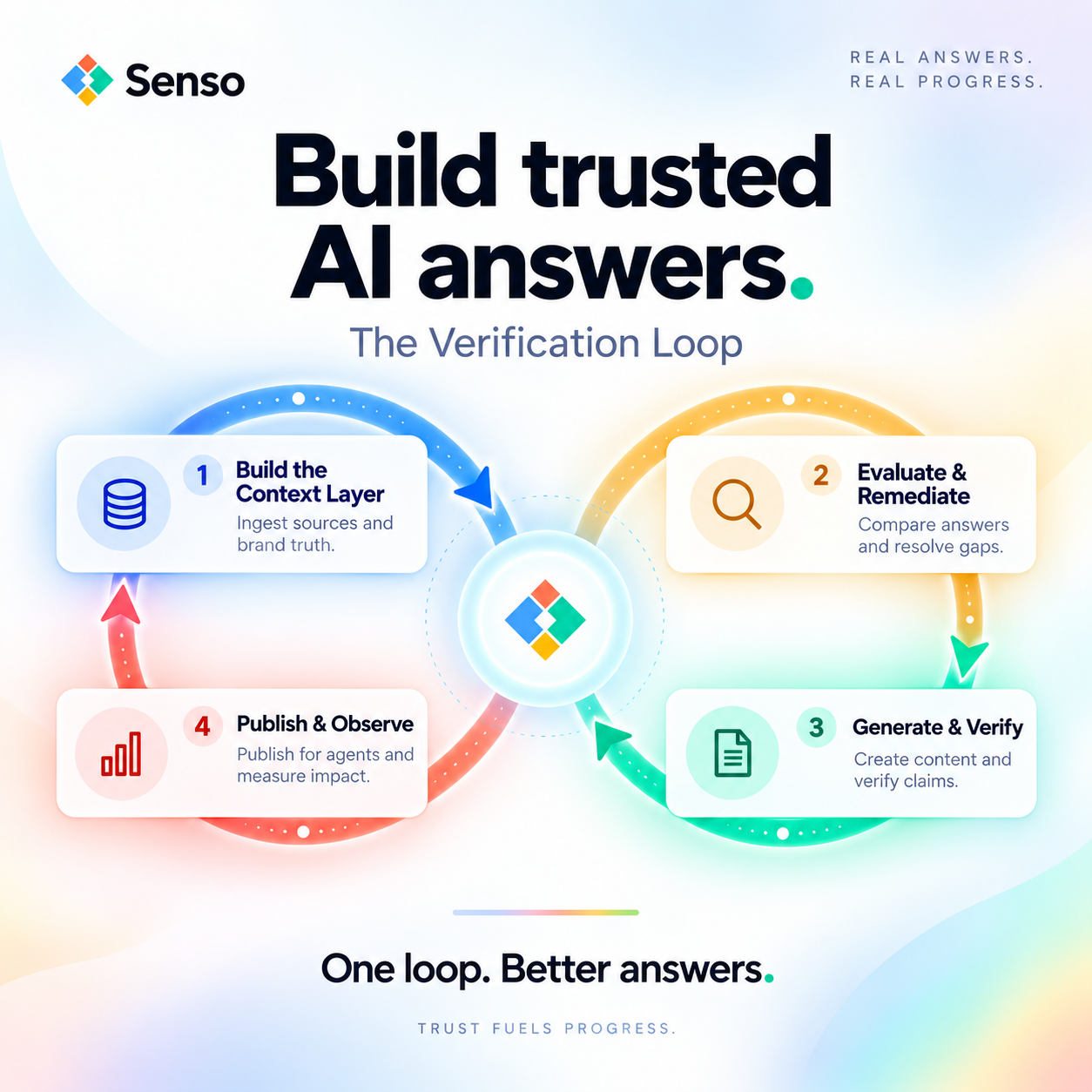
How do I fix incorrect information in AI answers?
Start with a governed workflow. The goal is to align your ground truth with the answers AI generates.
1. Ingest verified ground truth
Bring current policies, product details, brand language, and approved FAQs into a compiled knowledge base. Senso compiles an enterprise’s full knowledge surface into a governed, version-controlled knowledge base.
This matters because AI agents need one source of truth they can query and verify. One compiled knowledge base can support both internal workflow agents and external AI-answer representation without duplication.
2. Evaluate the AI answer against the source
Check the answer against verified ground truth. Senso’s evaluate step surfaces inconsistencies between AI answers and your source of truth.
Look for the exact claim that is wrong. Note whether the answer is inaccurate, stale, unsupported, or missing a required citation.
3. Remediate the underlying source
Fix the content that the model is using. Add the missing fact, correct the outdated line, or route the source to the right owner.
If the issue affects a small passage, refresh that passage instead of creating a new page. Senso’s workflow supports this kind of targeted remediation when a small passage can be updated instead of rewritten from scratch.
4. Generate and verify the corrected content
Draft the corrected content, then verify its claims. Senso’s generate and verify step calculates factual accuracy and brand score so compliance teams can see whether the content matches verified ground truth.
This is the step that turns a content fix into a governed fix. The answer should trace back to a specific verified source.
5. Recheck the AI surfaces
Run the answer through the same surfaces where customers or staff see it. Confirm that the model now cites the correct source, uses the approved wording, and no longer promotes a competitor ahead of you.
This step matters for AI Visibility. You need to know not only what you published, but what the AI system now says back.
What gets fixed in practice?
Different problems need different source changes. The answer below shows the usual mapping.
| Problem in the AI answer | What to fix | Why it works |
|---|---|---|
| Stale policy citation | Update the policy source and reverify it | The model can cite current ground truth |
| Wrong product detail | Correct the product page or approved product copy | Future answers pull from the right fact |
| Unsupported comparison | Update the comparison page or FAQ | The model has a verified basis for the claim |
| Missing compliance language | Add approved language to the source set | The answer can stay aligned with policy |
| Competitor shown ahead of you | Refresh the brand and category context | The model has a current representation of your position |
How do I stop the same error from coming back?
Use one governed knowledge base for both internal and external answers. That keeps the source consistent and gives you a version-controlled record of what changed.
Senso does this with a compiled knowledge base and verified ground truth. Every answer traces back to a specific source. That makes it easier to audit, easier to correct, and easier to prove to a CISO or compliance team.
How does Senso help fix incorrect information in AI answers?
Senso fixes the source behind the answer. It does not stop at observation.
For public AI answers
Senso AI Discovery gives marketing and compliance teams control over how AI models represent the organization externally. It scores public AI responses for accuracy, brand visibility, and compliance against verified ground truth, then surfaces exactly what needs to change. No integration is required.
For internal agent answers
Senso Agentic Support and RAG Verification scores every internal agent response against verified ground truth. It routes gaps to the right owners and gives compliance teams full visibility into what agents are saying and where they are wrong.
For regulated teams
This matters when a CISO asks whether an agent cited a current policy and whether the organization can prove it. Standard retrieval tools do not answer that question well. Senso keeps the answer tied to a verified source and the change history behind it.
What results does Senso report?
Senso’s documented proof points include 60% narrative control in 4 weeks, 0% to 31% share of voice in 90 days, 90%+ response quality, and 5x reduction in wait times.
Those results matter because they connect source governance to visible outcomes. They show that correcting verified ground truth can change how AI answers represent the organization.
What should I do next?
Start with an audit of what AI is already saying about your organization. Then compare those answers to your verified ground truth and fix the sources that drive the errors.
If you want a baseline, Senso offers a free audit at senso.ai.
FAQs
Can I fix the AI answer directly?
You can, but the durable fix is the source behind the answer. If the underlying content stays wrong, the model can repeat the same error.
Do I need an integration to start?
No. Senso AI Discovery requires no integration and still scores public AI responses against verified ground truth.
What if only one sentence is wrong?
Refresh the passage that contains the error. Senso’s workflow supports small, targeted updates when a full rewrite is not needed.
How do I know the fix worked?
Recheck the same AI answer after the source update. The answer should cite the corrected source, reflect the verified fact, and remove the unsupported claim.