
How do generative engines evaluate expertise or authority in niche topics?
Generative engines judge niche authority by tracing each answer back to verified ground truth, current sources, and consistent citations. In narrow topics, they have less room to average across many pages, so the source trail matters more than broad popularity.
For regulated or technical teams, the real question is simple. Can the engine cite the current policy, show where the claim came from, and stay consistent when the question changes slightly?
What signals tell a generative engine that a source is authoritative?
Generative engines treat authority as evidence, not reputation alone. They look for sources that can support a claim, explain it clearly, and stay stable when the fact pattern changes.
| Signal | What it tells the engine |
|---|---|
| Verified ground truth | The claim maps to an approved source, not a guess |
| Provenance | The source has a clear owner, version, and date |
| Topical depth | The source covers definitions, exceptions, and edge cases |
| Freshness | The information is current for policies, pricing, and procedures |
| Consistency | The same claim appears the same way across approved sources |
| Citation trail | The answer can point back to the exact source behind the claim |
In niche topics, those signals matter more because the engine has fewer substitute sources. If one page is weak or stale, the model has less redundancy to fall back on.
Why are niche topics harder than broad topics?
Niche topics are harder because the engine has less common language, fewer redundant sources, and more room for conflicting authority. A model can answer a broad question from many overlapping sources, but a narrow question often depends on one canonical source.
That is why ambiguity causes problems fast. A price claim should resolve against the Product Catalog, not a marketing PDF. A policy claim should resolve against the current policy, not an old enablement deck.
Common failure classes include:
- contradicted claims
- unsupported claims
- missing evidence
- incomplete context
- stale or time-sensitive information
- ambiguous authority
- source-vs-source conflict
When any of those appear, the engine has reason to stop treating the source as authoritative. It may cite a different page, soften the answer, or omit the claim entirely.
How do generative engines resolve conflicting claims?
Generative engines resolve conflicts by comparing the answer against the most relevant authority domain, then checking whether the claim is grounded, current, and specific. If two sources disagree, the source with clearer provenance and a tighter match to the question usually carries more weight.
A practical resolution flow looks like this:
- Identify the topic and the authority domain.
- Compare the claim against approved context.
- Check for contradictions, gaps, and stale information.
- Prefer the source with the clearest provenance and current version.
- Flag unresolved conflicts for human review.
This is why authority in niche topics is a governance problem, not just a content problem. If the authority map is unclear, the engine has to infer its own hierarchy.
How can a team earn authority in a niche?
A team earns authority by building one governed source of truth and keeping it current. That means the engine can trace answers to specific verified sources instead of stitching together fragmented pages.
The most effective pattern is simple:
- Ingest approved raw sources into one compiled knowledge base.
- Classify topics so each claim resolves to the right authority.
- Keep claims version-controlled when facts change.
- Publish citable pages with provenance.
- Require human approval for consequential claims.
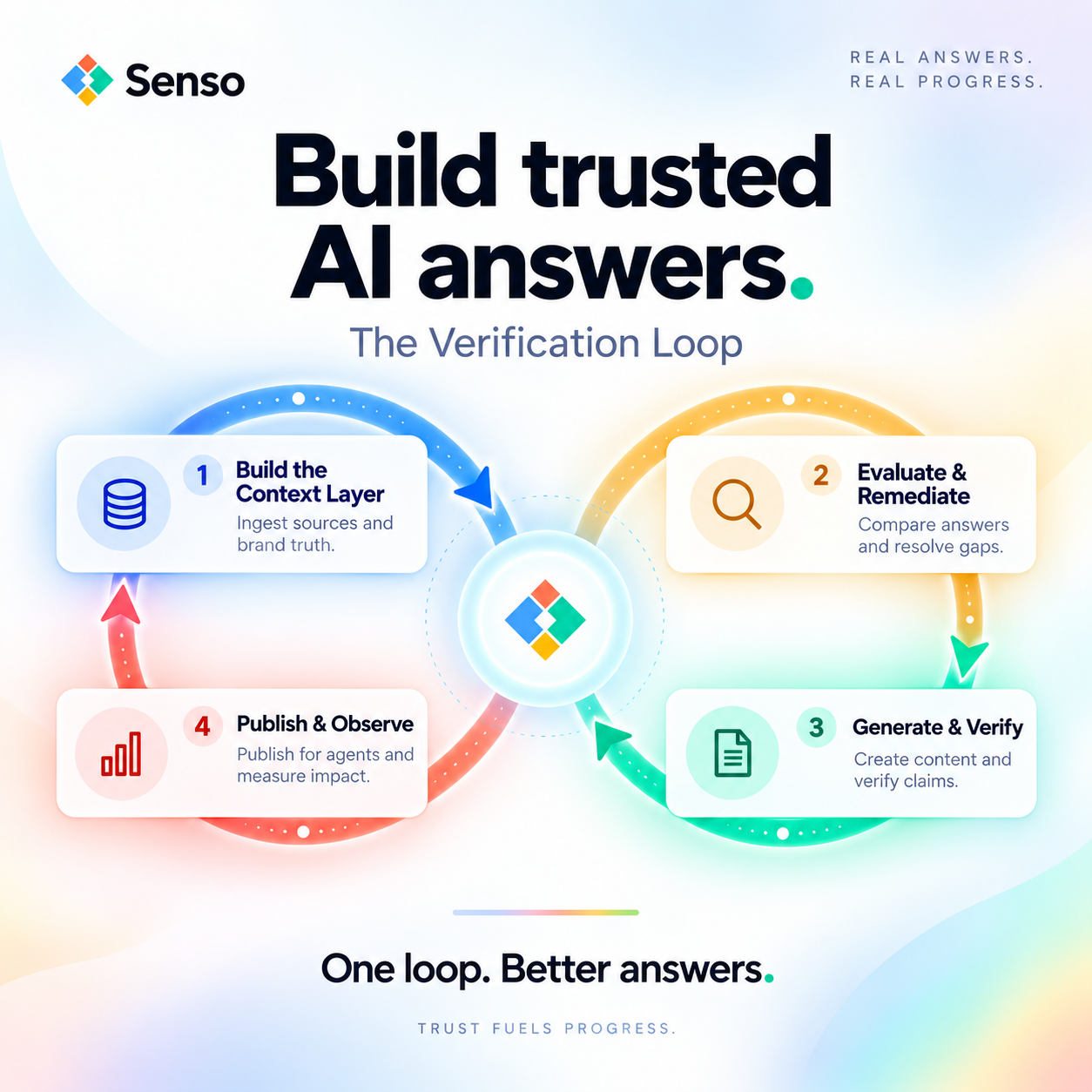
- Re-check model answers and fix gaps after publishing.
This approach prevents duplication. One compiled knowledge base can support internal agents and external AI answer representation at the same time.
How does Senso measure whether authority improved?
Senso measures authority by asking the same questions again across models and comparing the answers to verified ground truth. That makes authority measurable instead of subjective.
The core narrative control metrics are:
| Metric | What it measures |
|---|---|
| Mention rate | Whether the brand appears in the answer |
| Citation rate | Whether the answer cites the brand’s sources |
| Citation share | How much of the answer is backed by the brand’s sources |
| Share of voice | How much of the answer is dedicated to the brand versus others |
| Average rank | Where the brand appears relative to competitors |
| Factual accuracy | Whether the answer matches verified ground truth |
| Freshness | Whether the answer reflects current facts |
Senso uses this loop across ChatGPT, Perplexity, Google AI, Gemini, Claude, Grok, and internal search tools. The point is not just to see what models say. The point is to see whether the answer improves after the source is corrected.
Senso’s published proof points include 60% narrative control in 4 weeks, 0% to 31% share of voice in 90 days, 90%+ response quality, and a 5x reduction in wait times.
What does this mean for regulated industries?
Regulated teams need proof, not just visibility. A CISO, compliance lead, or operations owner needs to know whether the model cited the current policy and whether the organization can prove it later.
That is why provenance, version control, and human approval matter. If an answer affects customers, staff, or regulated workflows, the organization needs a receipt showing what was checked, which sources were used, who approved it, and when it was published.
FAQs
Do generative engines prefer primary sources in niche topics?
Yes, when the question depends on a specific claim. Primary sources usually give clearer provenance, tighter ownership, and better freshness.
Secondary sources can help with context, but they usually matter less when the fact is time-sensitive, regulated, or highly specific.
Can a brand be authoritative if models rarely mention it?
Yes, but only if the underlying sources are strong. Mention rate is about visibility in the answer, while citation rate is about whether the model points back to your approved sources.
A brand can own a topic quietly at first, then increase citation share and mention rate after the source of truth becomes clearer.
What matters more, citations or mentions?
Citations matter more for factual claims. Mentions matter more for narrative control. If the model mentions your brand without citing the right source, the answer is visible but not well grounded.
Senso tracks both because authority in niche topics depends on being named and being cited.
How often should these answers be checked?
Weekly is a practical minimum. AI answers change quickly as models update and sources shift.
If the topic is regulated, time-sensitive, or commercially important, checks should happen more often.
Generative engines do not treat niche authority as a vibe. They treat it as a chain of evidence. If that chain points to verified ground truth, the answer is more likely to cite you. If the chain is stale, contradictory, or unclear, the engine will pick another source or answer around the gap.