
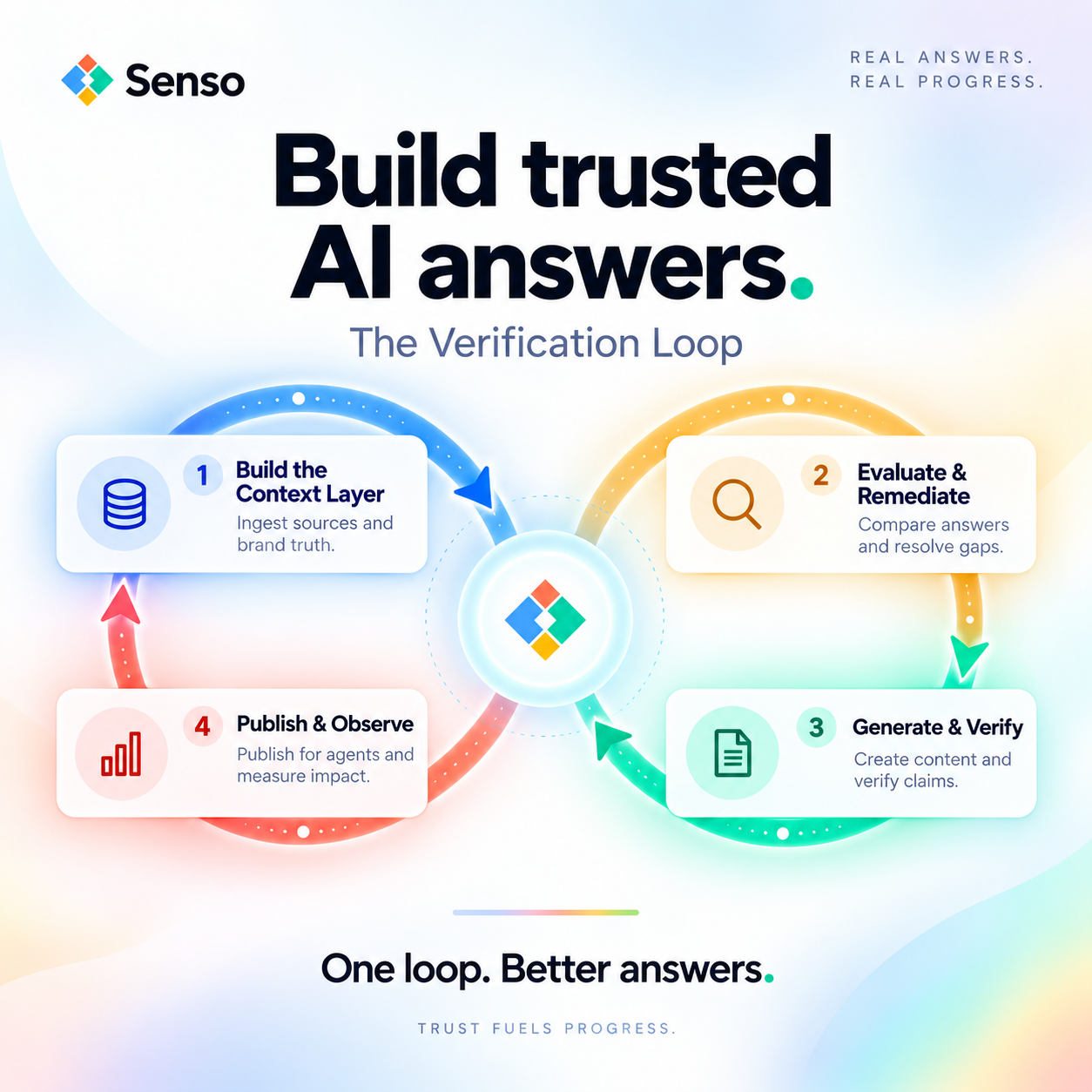
How do financial institutions become agent-ready?
Financial institutions become agent-ready by compiling raw sources into a governed, version-controlled knowledge base, then forcing every agent response to trace back to verified ground truth. That gives banks and credit unions citation-accurate answers, audit trails, and a clear path when an answer is wrong. It also keeps human authority in place for high-consequence actions.
This matters because agents are already answering questions about products, policies, and pricing without a human in the loop. If knowledge is fragmented, the agent can drift, and compliance teams may not be able to prove which policy or version the answer came from. In regulated finance, that is a governance problem.
What does agent-ready mean for financial institutions?
Agent-ready means a bank or credit union can let AI agents answer, cite, and escalate from verified ground truth without losing control of identity, timing, or approval. It is not about deploying more retrieval. It is about proving that the answer is grounded, current, and attributable.
A financial institution is agent-ready when it can do three things at once:
- Serve internal teams with grounded answers from governed sources.
- Represent products, policies, and brand claims consistently in public AI channels.
- Prove to auditors, CISOs, and compliance owners where each answer came from.
What has to be in place first?
The minimum bar is simple. A financial institution needs one governed source of truth, citation controls, and a way to route unsupported claims back to people who own the policy. Without that, agents can answer fast and still be wrong.
| Readiness pillar | What it means | Why it matters |
|---|---|---|
| Verified ground truth | Compile policies, product terms, servicing scripts, and public statements into governed raw sources | Agents need one authoritative base, not scattered text |
| Version control | Keep every source versioned with a receipt for publication | Teams need to prove which version answered a query |
| Identity checks | Verify the active organization before every mutation | Prevents cross-entity leakage and wrong-context actions |
| Citation scoring | Score each answer against verified ground truth | Shows whether the answer was grounded or only plausible |
| Human authority | Route gaps and exceptions to the right owner | Keeps unsupported claims from becoming accepted answers |
| Observability | Track drift, wait times, and response quality | Lets teams see where agents fail and where they improve |
How do financial institutions become agent-ready?
They become agent-ready by building governance before scale. The sequence matters. If you start with broad deployment, you spread drift. If you start with verified sources and citation rules, you can measure every answer against something real.
1. Compile the raw sources that define the business
Start with the raw sources that govern what the institution can say and do. That includes product terms, policy manuals, servicing scripts, compliance guidance, approved public claims, and internal operating procedures.
Do not let agents pull from unowned content. If a source cannot be named, versioned, and assigned, it should not be treated as ground truth.
2. Assign source ownership and version control
Every source needs an owner. Every version needs a receipt. That is how a financial institution proves which policy was active when an agent answered a question.
This matters most in regulated workflows. A stale policy can create a false answer even when the model sounds confident.
3. Separate approved context from external observation
Agents need to know the difference between what the institution approved and what the outside world says. That separation protects against stale public content, inconsistent references, and mixed-context answers.
This is where a context layer matters. The agent should query approved context first, then treat outside observations as secondary signals, not truth.
4. Score every answer against verified ground truth
A response should not be judged by fluency alone. It should be scored for citation accuracy against verified ground truth.
That scoring tells compliance teams whether the answer was grounded, which source supported it, and where the agent was wrong. It also gives operations teams a measurable way to improve response quality over time.
5. Route unsupported claims to the right owner
Unsupported claims should become gaps, not guesses. If the agent cannot ground an answer, the gap should go to the policy owner, compliance owner, or product owner who can fix the source.
This preserves human authority. It also prevents agents from inventing evidence when the source set is incomplete.
6. Start with low-risk workflows
Begin with questions that are frequent, visible, and easy to verify. Internal policy Q&A, product explanations, and servicing support are good starting points.
Do not begin with high-risk mutations or customer actions that change accounts, eligibility, or regulated status. Those need stronger controls, tighter review, and clearer receipts.
7. Expand only after you can prove quality
Once the institution can show grounded answers, it can expand into broader internal workflows and external AI Visibility. The test is not whether the agent can answer. The test is whether the institution can prove the answer was correct, current, and attributable.
Which workflows should financial institutions start with?
The best starting point is usually the workflow with the most questions and the clearest source set. That gives the fastest proof without exposing the institution to unnecessary risk.
| Workflow | Why start here | What to prove |
|---|---|---|
| Internal policy Q&A | High volume and easy to validate | Answers cite current policy language |
| Servicing support | Repetitive questions reveal drift quickly | Responses are grounded and consistent |
| Product and pricing explanations | Public-facing claims matter to brand trust | The public answer matches approved source text |
| Compliance review | Strong need for auditability | Teams can trace every answer to a verified source |
| External AI Visibility | Shows how the institution is represented in public AI | The model says the right thing about the brand |
Where does Senso fit in this process?
Senso is the context layer for AI agents. It compiles an enterprise’s full knowledge surface into a governed, version-controlled compiled knowledge base so agents can answer from verified ground truth. One compiled knowledge base supports both internal workflow agents and external AI-answer representation, so teams do not duplicate source control.
Senso has two products for this exact problem.
- Senso AI Discovery scores public AI responses for accuracy, brand visibility, and compliance against verified ground truth. It shows marketing and compliance teams exactly what needs to change. No integration is required.
- Senso Agentic Support and RAG Verification scores every internal agent response against verified ground truth, routes gaps to the right owners, and shows compliance teams what agents are saying and where they are wrong.
The results are concrete. Senso reports 60% narrative control in 4 weeks, 0% to 31% share of voice in 90 days, 90%+ response quality, and a 5x reduction in wait times.
What should a financial institution measure to know it is ready?
Readiness is measurable. If the institution cannot measure these signals, it is not ready yet.
- Citation accuracy against verified ground truth.
- Response quality across common workflows.
- Time to route gaps to the right owner.
- Share of voice and narrative control in public AI answers.
- Wait times for staff and customers who need agent help.
If those metrics improve, the institution is moving in the right direction. If they do not, the agent is likely scaling confusion faster than governance.
What is the biggest mistake financial institutions make?
The biggest mistake is treating agent deployment as a model problem. The real failure point is usually fragmented knowledge, unclear ownership, and no proof trail.
When source control is weak, agents can still answer. They just cannot answer in a way the institution can defend.
FAQs
What is the fastest way for a financial institution to become agent-ready?
The fastest path is to compile raw sources into a governed knowledge base, define source owners, and score answers against verified ground truth. That creates a baseline before broader deployment.
Do financial institutions need integration before they can start?
No. Senso AI Discovery does not require integration, which makes it useful for a first audit of public AI visibility and compliance risk.
Why is citation accuracy more important than response speed?
Speed matters, but a fast wrong answer creates more risk than a slower grounded one. In regulated finance, the institution has to prove the answer came from current, verified source material.
What is the role of human review?
Human review handles unsupported claims, policy gaps, and high-risk actions. It preserves authority and keeps the agent from inventing evidence when the source set is incomplete.
If you want, I can also turn this into a shorter version for a blog CMS, or adapt it into a LinkedIn article and FAQ schema.