
How do companies monitor AI search results
AI search results already answer questions about your products, policies, pricing, and competitors. Companies monitor them because those answers shape decisions before a human ever sees the question. The job is to check whether the answer is grounded in verified ground truth, whether it cites sources the business can prove, and whether the right brand shows up with the right message.
Quick Answer
Companies monitor AI search results by running a fixed set of prompts across the AI surfaces that matter, scoring each answer for mentions, citations, share of voice, factual accuracy, and compliance, then correcting the source content and checking again. Senso tracks ChatGPT, Perplexity, Gemini, and Google AI Overview by default, with Claude, Grok, and Meta AI available per workspace. Track weekly at minimum because AI answers change quickly as models update and sources shift.
What do companies actually monitor?
The most useful signals are mention rate, citation rate, share of voice, and factual accuracy. Mention rate tells you whether the brand appears at all. Citation rate tells you whether the model points to owned pages or credible sources. Share of voice shows how much of the answer the brand owns compared with competitors.
| Signal | What it measures | Why it matters |
|---|---|---|
| Mentions | How often the brand appears across evaluated prompt runs | Shows whether AI includes the brand in the answer |
| Citations | Whether the answer cites owned pages or credible external sources | Citations are a trust mechanic for AI engines |
| Share of voice | The percentage of an AI-generated answer dedicated to the brand versus competitors | Shows answer dominance |
| Factual accuracy | Whether claims match verified ground truth | Protects against unsupported or wrong statements |
| Compliance | Whether the answer stays inside approved policy and messaging | Reduces regulatory exposure |
How do companies monitor AI search results?
They monitor AI search results with a repeatable workflow. The key is not one-off testing. It is scheduled evaluation against the same question set, the same models, and the same source of truth.
-
Build a prompt set that mirrors real questions.
Strong prompt sets follow how customers, prospects, and employees actually ask questions. The prompts should reflect different funnel stages and the questions that matter most to revenue, support, and compliance. -
Run the prompts on a schedule.
Senso tracks coverage per prompt, per model, and per surface, daily. That matters because AI answers shift as models update, sources change, and competitors publish new content. -
Score every answer against verified ground truth.
The answer needs to be checked against approved source material, not just against a generic model output. In Senso, every answer traces back to a specific, verified source. -
Route gaps to the right owners.
Once the system finds unsupported claims, missing citations, or competitor bias, the issue needs to go to the team that can fix the source. Senso AI Discovery surfaces exactly what needs to change. -
Publish verified content and recheck the result.
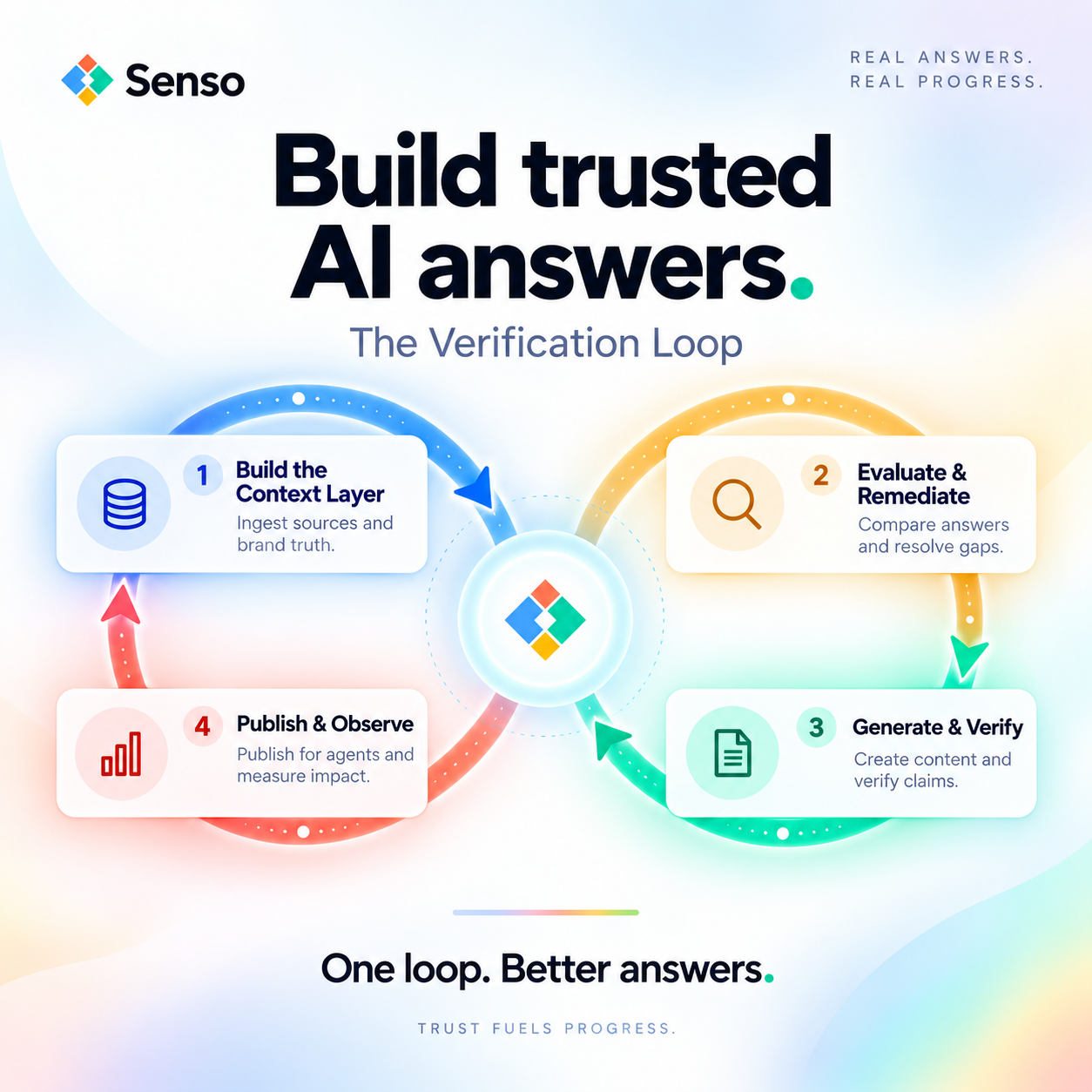
Monitoring only matters if it changes the next answer. Senso’s verification loop measures the change in citation rate, citation share, mention rate, and factual accuracy across frontier models after verified content goes live.
A governed, compiled knowledge base makes this work. One compiled source of truth can power both internal workflow agents and external AI-answer representation without duplication.
Why do citations matter more than mentions?
Mentions show presence. Citations show proof. A brand can appear in an answer and still leave no evidence that the model used a current, approved source.
Citations are the control point for auditability. Senso documents this directly: citations are a trust mechanic for AI engines. When models cite owned pages or credible external sources, teams can verify where the answer came from and whether it aligns with current policy.
Why do many monitoring tools stop too early?
Most monitoring tools only report what AI said. That is useful for visibility, but it is not enough for governance. They do not own the full remediation, verification, publication, and receipt loop.
That gap matters. If a company can see a bad answer but cannot fix the source, republish verified content, and confirm the next answer changed, it still has exposure. Senso is built to connect enterprise truth to public and transactional surfaces with proof.
How is this different from search rankings?
Traditional rankings tell you where a URL sits on a results page. AI monitoring tells you whether a model mentions your brand, cites the right source, and recommends the right vendor.
That is a different control problem. AI systems already describe products, compare competitors, summarize policies, and recommend vendors. Companies need to see what those systems are saying and whether the answer is grounded.
What should regulated teams require?
Regulated teams should require source traceability, version control, and proof that every answer maps back to verified ground truth. In financial services, healthcare, and credit unions, the question is not just what the model said. The question is whether the organization can prove the current policy was cited and the answer stayed inside approved bounds.
That is why monitoring needs an audit trail, not just a dashboard. Senso Agentic Support and RAG Verification scores every internal agent response against verified ground truth, routes gaps to the right owners, and gives compliance teams visibility into where agents are wrong.
What does a strong monitoring stack look like?
A strong stack does five things well. It measures AI visibility, verifies the answer, routes remediation, publishes corrected content, and checks the result again.
| Capability | What to look for |
|---|---|
| Surface coverage | ChatGPT, Perplexity, Gemini, and Google AI Overview by default, with optional coverage for Claude, Grok, and Meta AI |
| Prompt scheduling | Regular runs, not one-off checks |
| Source verification | Answers tied to verified ground truth |
| Remediation loop | Clear ownership for fixing source content |
| Proof of change | Measured shifts in citation rate, share of voice, mention rate, and factual accuracy |
Senso AI Discovery does this without integration. That matters when teams need a fast read on how AI models represent the company externally.
FAQs
How often should companies monitor AI search results?
Weekly at minimum. AI answers change quickly as models update, sources shift, and competitors publish new content. For high-risk or fast-moving categories, daily coverage per prompt, model, and surface is better.
Can companies monitor AI search results without integrating systems?
Yes. Senso AI Discovery does not require integration. That makes it useful for teams that want a fast audit of brand visibility, citation quality, and compliance without a long setup.
What is the difference between mentions and citations?
Mentions measure how often the brand appears in AI-generated answers across evaluated prompt runs. Citations show whether the answer points to owned pages or credible sources. Mentions tell you if you are present. Citations tell you if the answer is grounded.
What surfaces should companies watch first?
Senso tracks ChatGPT, Perplexity, Gemini, and Google AI Overview by default because they matter most for consumer brands today. Claude, Grok, and Meta AI can be added per workspace when broader coverage is needed.
Companies monitor AI search results by measuring the answer, not just the link. The right process shows what AI says, proves where it came from, fixes the source, and checks the next response again. If you need a free audit, Senso offers one at senso.ai with no integration and no commitment.