
How do companies influence citations in AI answers
Companies influence citations in AI answers by publishing verified, citable sources and by compiling their approved context into a governed knowledge base. They do not control the final wording. They control which sources the model can ground on, which claims are current, and whether the answer can trace back to verified ground truth.
That matters because AI agents already answer questions about products, policies, and pricing. If the source layer is fragmented, the model may cite someone else, omit the brand, or repeat stale claims. Senso measures that gap with mention rate, citation rate, citation share, share of voice, accuracy, and freshness.
What makes an AI answer cite one company instead of another?
AI answers cite one company instead of another when the model can find current, grounded sources with clear provenance and enough context to answer the query. Citations are a trust mechanic for AI engines. If the company’s own material is incomplete or inconsistent, the model often reaches for external citations or leaves the brand out entirely.
The main signals are simple.
| Signal | Why it affects citations |
|---|---|
| Verified ground truth | Gives the model a source it can defend |
| Clear provenance | Shows where the claim came from |
| Freshness | Reduces stale policy, pricing, or product claims |
| Coverage | Makes it more likely the brand is mentioned |
| Consistency | Prevents conflicting answers across pages |
For regulated teams, the issue is not just visibility. It is proof. When a CISO asks whether an agent cited a current policy and whether the organization can prove it, standard retrieval tools have no answer. That is the gap knowledge governance is meant to close.
How do companies influence citations in practice?
Companies influence citations by controlling the source layer, not the output layer. They compile approved raw sources into a governed knowledge base, publish approved citable sources with provenance, and keep the facts current enough for AI systems to rely on them.
A practical process looks like this.
- Ingest approved raw sources.
- Compile them into a governed, version-controlled knowledge base.
- Find factual gaps without interrupting everyday work.
- Require a human at consequential truth and publication gates.
- Publish approved, citable sources with provenance.
- Query the same AI surfaces again.
- Compare citation rate, citation share, mention rate, and share of voice.
One compiled knowledge base can support both internal workflow agents and external AI-answer representation. That removes duplication and keeps the source of truth consistent across surfaces.
What should companies publish?
Companies should publish approved first-party material that is citable, current, and easy to verify. The best sources are the ones AI systems can trace back to a specific claim, a specific page, and a specific approval path.
That usually means content such as:
- Product pages with clear claims
- Policy pages with current language
- FAQ pages that answer high-intent questions
- Support or help pages that explain how things work
- Public source pages with provenance
The goal is not volume. The goal is coverage and clarity. If the same facts appear in multiple approved places, the model has more chances to cite the right source. If those facts conflict, the model has more chances to ignore the brand or cite a competitor.
How do companies measure citation influence?
Companies measure citation influence with mention rate, citation rate, citation share, share of voice, rank, accuracy, and freshness. These metrics show whether the brand appears, whether it is cited, and how much of the answer it owns.
| Metric | What it tells you |
|---|---|
| Mention rate | Whether AI includes your brand |
| Citation rate | Whether AI cites owned pages or credible sources about you |
| Citation share | How much of the citation set points to you |
| Share of voice | How much of the answer is dedicated to your brand |
| Average rank or relative position | Where your brand appears among alternatives |
| Accuracy and freshness | Whether the cited claims are current and grounded |
Track weekly at minimum. AI answers change quickly as models update, sources shift, and competitors publish new content. If you only check once a quarter, you miss most of the drift.
What does a governed citation loop look like?
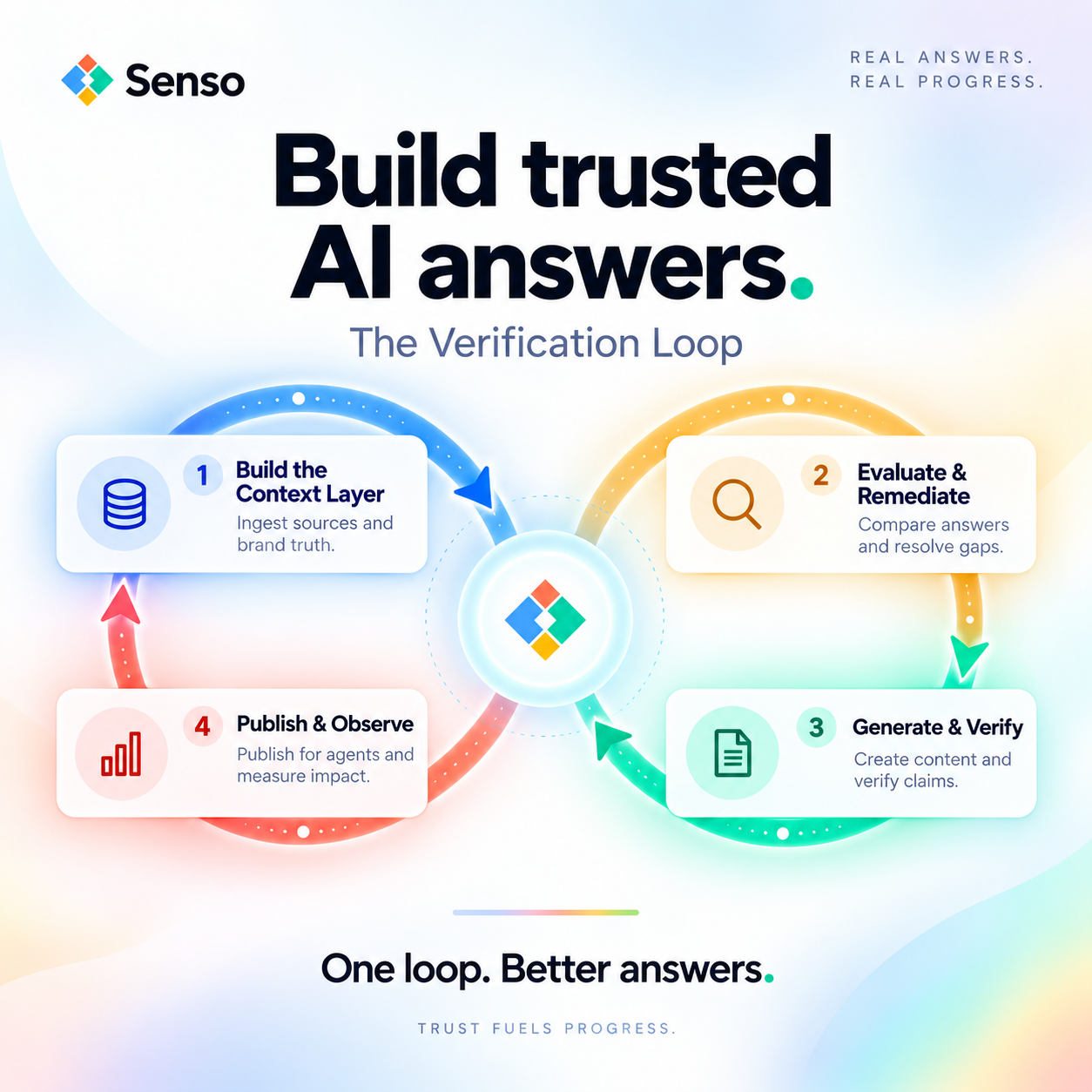
A governed citation loop starts with approved context and ends with a new baseline after the model is queried again. The purpose is not to force the model to say what you want. The purpose is to make sure the model has the right verified ground truth to work from.
The cycle is:
- Ingest approved context
- Evaluate AI answers
- Remediate the source
- Generate verified content
- Obtain human approval
- Publish approved sources with provenance
- Query the same models and locations again
- Compare the new results to the prior baseline
That loop gives teams a receipt showing what was checked, which sources were used, who approved it, and when it was published. It also makes the next review cycle faster because the baseline is already defined.
How does Senso help companies influence citations?
Senso helps by compiling verified context, scoring AI responses against ground truth, and showing where the source layer needs work. It is built for the problem where AI agents already represent the organization, but the organization cannot yet prove the answer path.
Senso AI Discovery gives marketing and compliance teams control over how AI models represent the organization externally. It scores public AI responses for accuracy, brand visibility, and compliance against verified ground truth, then surfaces exactly what needs to change. No integration is required.
Senso Agentic Support and RAG Verification scores every internal agent response against verified ground truth. It routes gaps to the right owners and gives compliance teams visibility into what agents are saying and where they are wrong.
Documented outcomes include:
- 60% narrative control in 4 weeks
- 0% to 31% share of voice in 90 days
- 90%+ response quality
- 5x reduction in wait times
Those outcomes come from governed citation work, not from trying to control the model itself.
What mistakes reduce citations?
The biggest mistake is treating AI citations like a branding problem instead of a knowledge governance problem. If the source layer is weak, the model has little reason to cite your company.
Common failure points include:
- Conflicting claims across pages
- Stale policy or pricing information
- Missing provenance
- No human approval at publication gates
- No weekly review of AI answers
- No baseline for mention rate or citation share
Another mistake is assuming external model answers overwrite ground truth. They do not. External answers are observations. They show where the gap is. They do not replace the approved source of record.
Can companies force a citation in AI answers?
No. Companies can improve the odds, but they cannot dictate the final answer. They can make approved, grounded sources easier to find, easier to verify, and easier to cite.
That is the difference between control and governance. Control tries to command the output. Governance makes sure the source layer is ready for whatever the model returns.
What is the fastest way to improve citation share?
The fastest path is to close factual gaps and publish citable sources with provenance. Start with the questions that matter most to buyers, staff, or regulators. Then compile the approved answers into a governed source layer and query the same AI surfaces again.
If the model can cite your verified ground truth, citation share can move. If it cannot, the model will keep relying on external sources or omit the brand entirely.
How often should teams review AI citations?
Teams should review them weekly at minimum. AI answers change quickly, and the source layer changes with them.
Weekly review helps teams catch:
- New competitor content
- Updated model behavior
- Stale company claims
- Missing citations
- Shifts in share of voice
For regulated industries, weekly review also creates a practical audit rhythm. That is often the difference between knowing what AI says and being able to prove it.
FAQ
Can AI systems cite both owned pages and external sources?
Yes. AI systems can cite owned pages or credible external sources about your company. The key question is whether those sources are current, grounded, and approved.
Do citations improve automatically if a company publishes more content?
No. More content only helps if it is citable, consistent, and based on verified ground truth. Volume without governance usually adds noise.
What matters more, mention rate or citation rate?
Both matter, but they answer different questions. Mention rate tells you whether the brand appears. Citation rate tells you whether the model can back the answer with a source you stand behind.
Why do compliance teams care about citations?
Compliance teams care because citations create traceability. If an AI answer affects policy, pricing, or customer guidance, the company needs to know which source supported it and who approved it.
If you want, I can turn this into a version tailored for regulated industries, or a version that is more product-led for Senso.ai.