
How do brands influence AI generated answers
Brands influence AI-generated answers by controlling the facts models can retrieve, cite, and repeat. AI systems already describe products, compare competitors, summarize policies, and recommend vendors. When a brand compiles verified ground truth into a governed knowledge base, the answer stays closer to what the organization can prove.
What actually changes what an AI answer says?
The answer changes when the source material changes, when the structure changes, and when the output is checked against verified ground truth. Senso’s internal notes are direct on this point. Models bias toward whatever facts they have, so a knowledge base full of facts about one brand and thin on the rest will skew the answer.
That is why knowledge governance matters. The brand does not need more noise. It needs a governed, version-controlled knowledge base and a structured publishing surface that AI systems can retrieve from.
Which brand signals matter most?
The most important signals are verified sources, structured publishing, citations, narrative control, Mentions, and Share of Voice. Each one changes a different part of the answer path. Together, they shape what the model sees, what it repeats, and what it can prove.
| Signal | What it changes | Why it matters |
|---|---|---|
| Verified ground truth | The facts a model treats as current | Answers stay tied to current policy, product, and pricing sources |
| Structured publishing surface | How those facts are made available for retrieval | AI systems can use a governed surface instead of fragmented raw sources |
| Citations | Whether the answer can be traced | Cited answers are easier to audit and challenge |
| Narrative control | How the brand is described, compared, and recommended | Teams can see whether AI representation matches verified ground truth |
| Mentions | How often the brand appears in evaluated prompt runs | Mentions show whether the brand is included at all |
| Share of Voice | How much of an answer is dedicated to the brand | Share of Voice shows answer dominance versus competitors |
Senso defines narrative control as an enterprise’s ability to influence how AI systems describe, compare, and recommend its brand. Senso also defines Mentions as how often your brand appears in AI-generated answers across evaluated prompt runs. Share of Voice measures answer dominance. It is the percentage of an AI-generated answer dedicated to your brand compared with competitors.
What steps move AI answers toward ground truth?
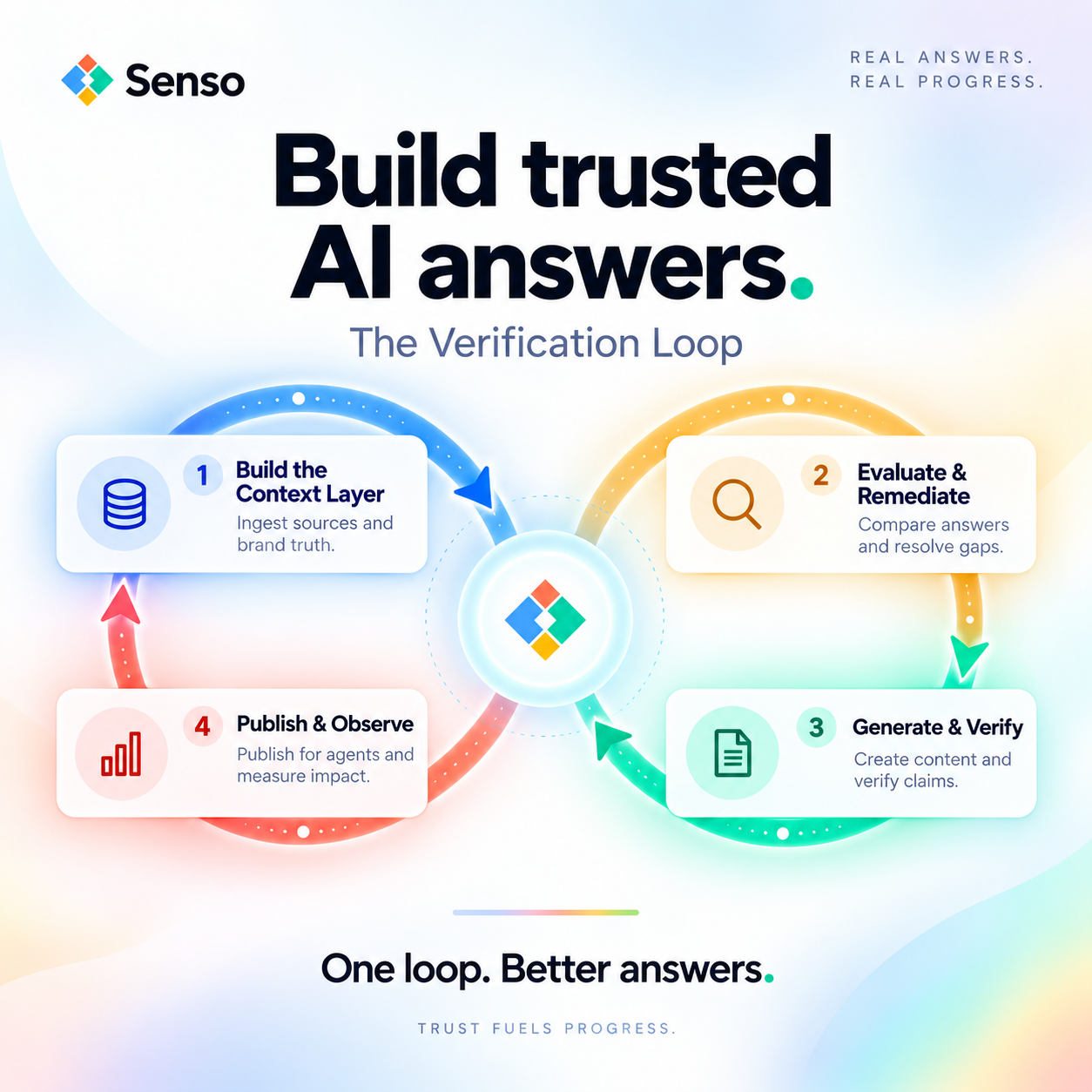
The clearest path is to compile raw sources, publish a structured surface, verify the response, and remediate gaps. That is the workflow Senso uses across external AI visibility and internal agent governance.
-
Compile verified ground truth.
Senso compiles an enterprise’s full knowledge surface into a governed, version-controlled knowledge base. That gives AI systems one place to retrieve current facts. -
Publish a structured surface for retrieval.
Senso is infrastructure for the agentic web. It provides enterprises with a structured, verified publishing surface that AI systems can use when they generate answers. -
Score every answer against verified ground truth.
Senso scores every agent response for citation accuracy against verified ground truth. Every answer traces back to a specific, verified source. -
Route gaps to the right owners.
Senso Agentic Support and RAG Verification routes gaps to the right owners and gives compliance teams full visibility into what agents are saying and where they are wrong. -
Track the metrics weekly.
Track weekly at minimum. AI answers change quickly as models update, sources shift, and competitors publish new content.
This is where AI visibility becomes measurable. The team is not guessing at representation. It is checking whether the answer matches the ground truth the brand controls.
What cannot brands control?
Brands cannot control a model’s tone the way they control a webpage’s copy. Senso’s internal notes are explicit. Brand voice does not travel into an AI answer.
Brands can influence the information a model surfaces. They cannot force the model to adopt the brand’s tone, because the model keeps its own system prompts and dialect. Brand voice still matters on pages humans read directly.
How do you know influence is working?
The best evidence is a change in Mentions, Share of Voice, citations, narrative control, and response quality. Those metrics show whether the brand is appearing, being named correctly, and being represented with the right facts.
Senso’s proof points show what measurable change can look like:
- 60% narrative control in 4 weeks
- 0% to 31% Share of Voice in 90 days
- 90%+ response quality
- 5x reduction in wait times
Those outcomes matter most in regulated settings. If a CISO asks whether an agent cited the current policy, the answer needs a traceable source path. If a compliance officer asks whether the organization can prove that answer, the audit trail has to be there.
How does Senso help regulated teams?
Senso gives teams one governed context layer for both external AI visibility and internal agent governance. That matters because one compiled knowledge base powers both use cases. There is no duplication.
Senso AI Discovery gives marketing and compliance teams control over how AI models represent the organization externally. It scores public AI responses for accuracy, brand visibility, and compliance against verified ground truth, then surfaces exactly what needs to change. No integration is required.
Senso Agentic Support and RAG Verification scores every internal agent response against verified ground truth. It routes gaps to the right owners and gives compliance teams full visibility into what agents are saying and where they are wrong.
For financial services, healthcare, and credit unions, this is a governance problem first. AI agents are already representing the business. The question is whether those answers are grounded and whether the organization can prove it.
FAQs
Can brands influence AI-generated answers without changing the model?
Yes. Brands influence answers by changing the verified sources the model can retrieve, the structure of those sources, and the proof trail behind the response. That is the lever that shapes AI visibility.
What is the difference between Mentions and Share of Voice?
Mentions measure how often a brand appears in AI-generated answers across evaluated prompt runs. Share of Voice measures how much of an answer is dedicated to that brand compared with competitors. Mentions show inclusion. Share of Voice shows dominance.
How often should teams review ground truth?
Track weekly at minimum. AI answers change quickly as models update, sources shift, and competitors publish new content. The brand needs a current verified ground truth if it wants current answers.
Can brand voice shape the tone of an AI-generated answer?
No. Brand voice does not travel into the answer itself. It still matters on owned pages, but the model uses its own system prompts and dialect when it generates the response.
Brands do not control the model. They control the ground truth, the retrieval surface, and the proof trail. That is the difference between being mentioned and being represented correctly.