
How do AI Systems Compare Brands?
AI systems compare brands by compiling what they can verify, then using that evidence to decide which brands to mention, rank, or recommend in a given answer. The brands with stronger verified ground truth, clearer citations, and more consistent narrative control usually appear more often and with better context.
This matters because AI systems already describe products, compare competitors, summarize policies, and recommend vendors. When your brand facts are fragmented or stale, the model compares you from whatever it can trust, not from what your team intended.
What do AI systems compare when they compare brands?
AI systems compare brands using evidence quality, not brand claims. They weigh whether the model can verify the facts, cite the source, and resolve the prompt from current information.
| Signal | What AI systems look at | Why it affects the comparison |
|---|---|---|
| Verified ground truth | Current approved facts about products, policies, pricing, and positioning | Gives the model a source it can trust and summarize |
| Owned citations | Whether the answer cites your primary pages | Owned citations are the strongest signal that AI systems trust your primary sources |
| External citations | Credible third-party sources that mention your brand | External citations also matter when AI systems compare brands |
| Mentions | How often your brand appears in evaluated AI answers | Mentions show whether the brand is included at all |
| Share of Voice | The percentage of an AI-generated answer dedicated to your brand | Share of Voice shows answer dominance in comparisons |
| Narrative control | How much you influence how AI systems describe, compare, and recommend your brand | Narrative control measures how well your brand story holds up in answers |
| Response quality | Whether the answer is citation-accurate and grounded | Poor response quality leads to wrong comparisons and compliance risk |
How do AI systems decide which brand wins a comparison?
AI systems usually favor the brand they can support with the clearest evidence. If they can verify the facts, cite the source, and connect the answer to current ground truth, that brand is more likely to appear in the comparison.
The prompt shape matters too. Ranking prompts, comparison prompts, and brand-specific prompts can return different results because each one asks for a different answer format. Senso’s documentation calls these prompt types out directly, which is why the same brand can show up in one query and disappear in another.
Why do some brands get compared incorrectly?
Brands get compared incorrectly when their knowledge surface is fragmented. Most enterprise knowledge is too unstructured for agents to use reliably, so the system may pull stale facts, incomplete product details, or inconsistent policy language.
The biggest failure points are simple:
- The brand facts live in too many places.
- The approved version is not clear.
- Public pages and internal guidance do not match.
- The model cannot cite a current source with confidence.
That is why AI can misstate products, compare competitors on outdated claims, or recommend a vendor using old information. When the evidence is weak, the comparison is weak.
How do you make AI systems compare your brand more accurately?
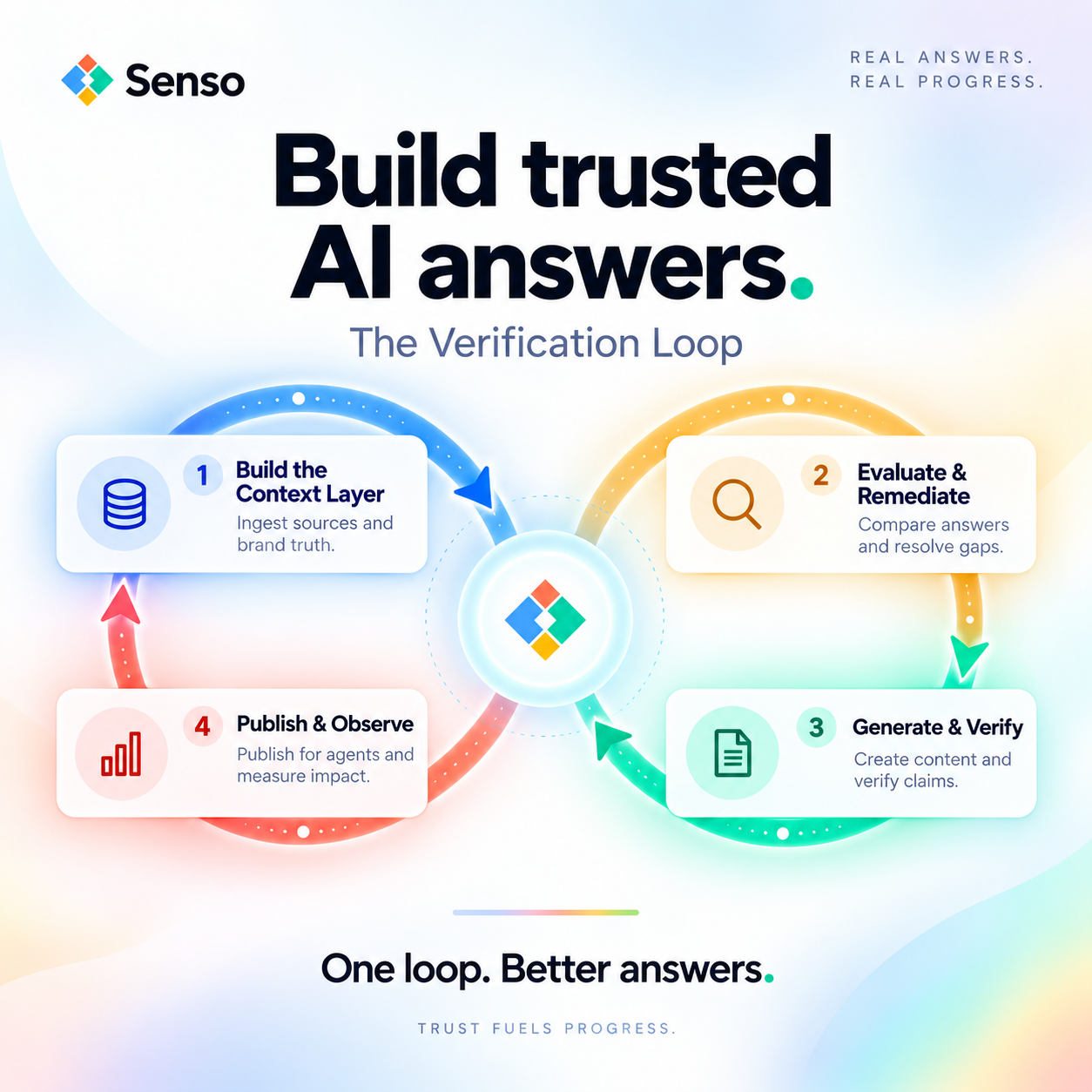
You make the comparison better by governing the facts first. The practical fix is to compile raw sources into a governed, version-controlled knowledge base, then score AI answers against verified ground truth.
A strong workflow looks like this:
-
Ingest raw sources into one compiled knowledge base.
Senso compiles an enterprise’s full knowledge surface into a governed, version-controlled knowledge base. That gives agents one source of truth instead of many conflicting ones. -
Define verified ground truth for the facts that matter.
Use approved product, policy, and messaging sources so the model can cite current information. -
Evaluate AI answers against those sources.
Senso evaluates real AI answers against verified ground truth and detects gaps like missing citations and low Share of Voice. -
Route gaps to the right owners.
When the answer is wrong, the issue should go to the team that owns the fact, not stay buried in an analytics report. -
Track AI Visibility over time.
AI Visibility metrics measure how visible, credible, and influential your brand is inside AI-generated answers. Track mentions, Share of Voice, and narrative control on a regular cadence.
What should regulated teams care about most?
Regulated teams should care about citation accuracy, auditability, and proof. The question is not only whether the answer sounds right. The question is whether the organization can prove which source the agent used.
This matters most in industries where trust, accuracy, and comparison drive decisions. Senso’s documentation calls out finance, healthcare, and credit unions as categories where the impact is largest. In those environments, a wrong comparison can create compliance exposure as well as customer confusion.
What does good brand comparison look like in practice?
Good brand comparison produces grounded answers with traceable sources. It also improves the metrics that matter to marketing and compliance.
Senso’s proof points show what that can look like:
- 60% narrative control in 4 weeks
- 0% to 31% Share of Voice in 90 days
- 90%+ response quality
- 5x reduction in wait times
Those outcomes matter because they show more than visibility. They show that the brand can prove what AI systems say about it.
FAQs
What is AI Visibility?
AI Visibility is how visible, credible, and influential your brand is inside AI-generated answers. It is not traditional ranking. Mentions, Share of Voice, and citation quality tell you more about AI comparison than URL position does.
What is the difference between mentions and Share of Voice?
Mentions measure how often your brand appears in AI-generated answers across evaluated prompt runs. Share of Voice measures answer dominance. It is the percentage of the AI-generated answer dedicated to your brand compared with competitors.
Why are owned citations important?
Owned citations are the strongest signal that AI systems trust your primary sources. External citations matter too, but owned sources give the model the clearest path back to verified ground truth.
How often should brand facts be reviewed?
Review brand facts on a regular cadence and whenever facts change. Senso’s documentation recommends tracking AI answers weekly at minimum because models, sources, and competitor content change quickly.
What is the fastest way to improve brand comparisons in AI systems?
Start with the facts. Compile the raw sources, define verified ground truth, and evaluate real AI answers against it. That gives you a governed base for both internal agents and external AI-answer representation without duplication.
If you want, I can turn this into a more conversion-focused version for Senso’s site or a more neutral thought-leadership version for the same topic.