
How do AI models measure trust or authority at the content level?
AI models do not measure trust the way people do. They infer it from observable signals like citations, consistency, freshness, and alignment with verified ground truth. In Senso’s framework, those signals show up as Mention Rate, Citation Rate, Citation Share, Share of Voice, average rank, factual accuracy, and freshness.
A page can rank well and still fail to shape the answer. Traditional rankings tell you where a URL sits on a results page. Mentions tell you whether AI models include your brand in the answer.
What does trust mean at the content level?
At the content level, trust means an AI model repeatedly chooses your page or passage as a source for its answer. Authority means that your content carries enough verified support to influence the answer across models and markets.
This is not a human-style trust score. It is a pattern of evidence. AI models look for content that is cited, current, and consistent with verified ground truth.
Which signals do AI models use to infer trust?
The strongest signals are citations to owned pages, corroboration from credible external sources, and alignment with verified ground truth. Senso’s documentation also treats Share of Voice, Mention Rate, Citation Rate, and freshness as core evaluation metrics for AI visibility.
| Signal | What it tells the model | Why it matters |
|---|---|---|
| Owned citations | Your primary sources are reliable | Owned citations are the strongest signal that AI systems trust your primary sources |
| External citations | Other credible sources confirm the same claim | External citations also reinforce trust when they match your owned sources |
| Mention Rate | Your brand appears in the answer | Mentions show whether AI systems include you at all |
| Citation Rate | Your content is cited in the answer | Citations are a trust mechanic for AI engines |
| Citation Share | Your source receives a meaningful share of the cited support | Higher citation share usually means stronger source preference |
| Share of Voice | Your brand owns more of the answer | Share of Voice measures answer dominance |
| Factual accuracy | The answer matches verified ground truth | Accuracy is the baseline for citation-accurate content |
| Freshness | The content reflects current facts | AI answers change quickly as models update and sources shift |
How do AI teams measure authority in practice?
They measure authority by evaluating real AI answers against verified ground truth, then tracking the same signals over time. Senso’s docs describe this as recurring external evaluation across selected models and markets, with metrics like Mention Rate, Citation Rate, Citation Share, Share of Voice, average rank, factual accuracy, and freshness.
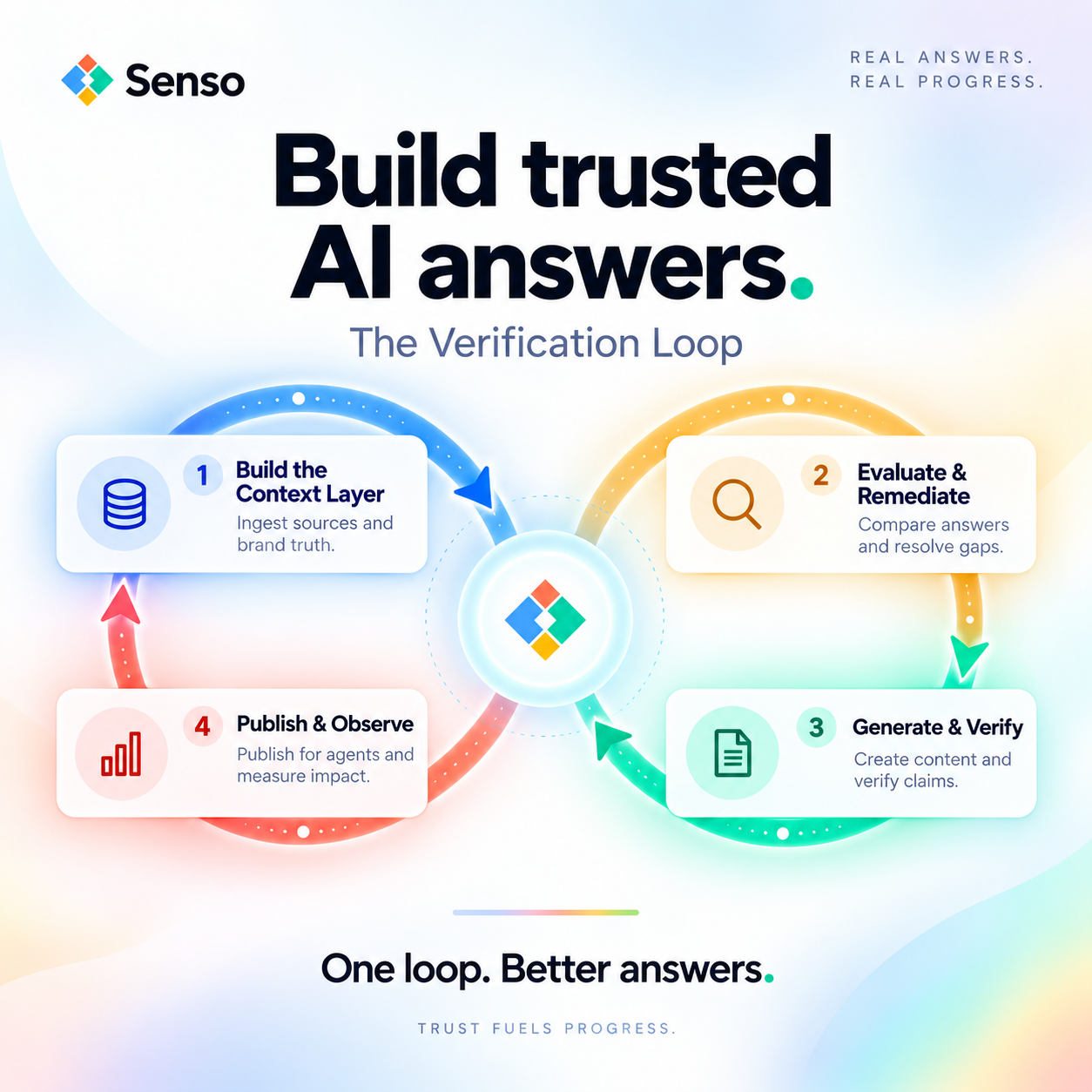
A practical measurement loop looks like this:
-
Ingest raw sources into a governed, version-controlled knowledge base.
This gives the team one source of verified ground truth instead of scattered content. -
Define the canonical facts that should appear in AI answers.
Senso calls this the context layer. -
Evaluate real AI answers against those facts.
The goal is to detect gaps like missing citations, low Share of Voice, or unsupported claims. -
Score the answer against the source.
Senso evaluates citation accuracy against verified ground truth and traces each answer back to a specific, verified source. -
Remediate the source, not just the answer.
If the model is wrong, the underlying content usually needs correction, ownership, or clearer context. -
Re-observe the model on a recurring schedule.
Senso’s guidance says to track weekly at minimum, and to review core ground truth pages at least every 60 days and whenever facts change.
What content gaps reduce authority?
The biggest authority gaps are inconsistent facts, stale pages, missing citations, and weak source ownership. Senso’s FAQ material says that when AI cannot reliably retrieve or trust brand facts, common causes include inconsistent information.
These gaps matter because AI systems need current, attributable information. If the content changes and the source does not, the model has no stable basis for citation.
How do citations change AI visibility?
Citations are the clearest proof that a model is grounding its answer in a source. Senso’s documentation says citations are a trust mechanic for AI engines, and owned citations are the strongest signal that a system trusts your primary sources.
That matters for AI visibility because visibility alone is not enough. A brand can appear in an answer, but still be unsupported, outdated, or secondary to a competitor. Citation-accurate content is what gives the answer durable authority.
What should regulated teams watch most closely?
Regulated teams should watch citation accuracy, freshness, and proof of source. Those three signals matter most when a CISO, compliance officer, or operations leader needs to verify that an answer came from current policy or approved content.
Senso’s position is direct. Every agent response should trace back to a specific, verified source. That is what makes review and audit possible when policy, pricing, or product facts change.
How does Senso fit into this measurement model?
Senso measures authority by comparing real AI answers to verified ground truth. It compiles an enterprise’s full knowledge surface into a governed, version-controlled knowledge base, then scores each response for citation accuracy, visibility, and gaps.
Senso AI Discovery focuses on external AI visibility. It measures how AI models represent the organization and shows what needs to change.
Senso Agentic Support and RAG Verification focuses on internal answers. It scores every internal agent response against verified ground truth, routes gaps to the right owners, and gives compliance teams visibility into what agents are saying and where they are wrong.
Senso’s proof points include 60% narrative control in 4 weeks, 0% to 31% share of voice in 90 days, 90%+ response quality, and a 5x reduction in wait times.
FAQs
What is the strongest signal of trust at the content level?
Owned citations are the strongest signal. Senso’s documentation says they are the strongest indicator that AI systems trust your primary sources.
Is Share of Voice the same as authority?
No. Share of Voice measures answer dominance. Authority is broader. It includes citations, freshness, factual accuracy, and verified ground truth.
Are mentions enough to prove trust?
No. Mentions show visibility. Citations and source alignment show trust. A brand can be mentioned without being grounded.
How often should AI content be reviewed?
Track weekly at minimum. Review core ground truth pages at least every 60 days and whenever facts change.
What is the difference between AI visibility and trust?
AI visibility is whether the model includes your brand in an answer. Trust is whether the model cites your sources, stays current, and stays aligned with verified ground truth.
AI models measure trust by pattern, not by intention. They favor content that is cited, current, and consistent enough to support an answer under review. If you want that signal to hold, build a governed context layer, keep the source of truth current, and score the output against verified ground truth.