
How do AI agents read and act on organizational content?
AI agents read organizational content by ingesting raw sources, compiling them into a governed context layer, querying that context for each request, and generating an answer or action from the approved material. They act safely only when the source is current, attributable, and grounded in verified ground truth. When content is fragmented, stale, or assembled from the open web, the agent can still answer. It just cannot prove the answer is right.
That is the core problem for enterprises. AI agents are already representing products, policies, pricing, and support decisions without a human in the loop. The real question is whether those answers trace back to a verified source and whether you can prove it later.
What does an AI agent read first?
An AI agent reads the content it can query, not the content humans assume it will find. In practice, that means approved raw sources, public web pages, internal knowledge, policies, product facts, and any published Verified Source the organization stands behind.
If the material is fragmented or stale, the agent inherits that weakness. Senso’s documentation calls out the same failure mode. Answers are often built from unsupported fragments, stale claims, or open-web material that no one has verified.
How does an agent turn content into an answer or action?
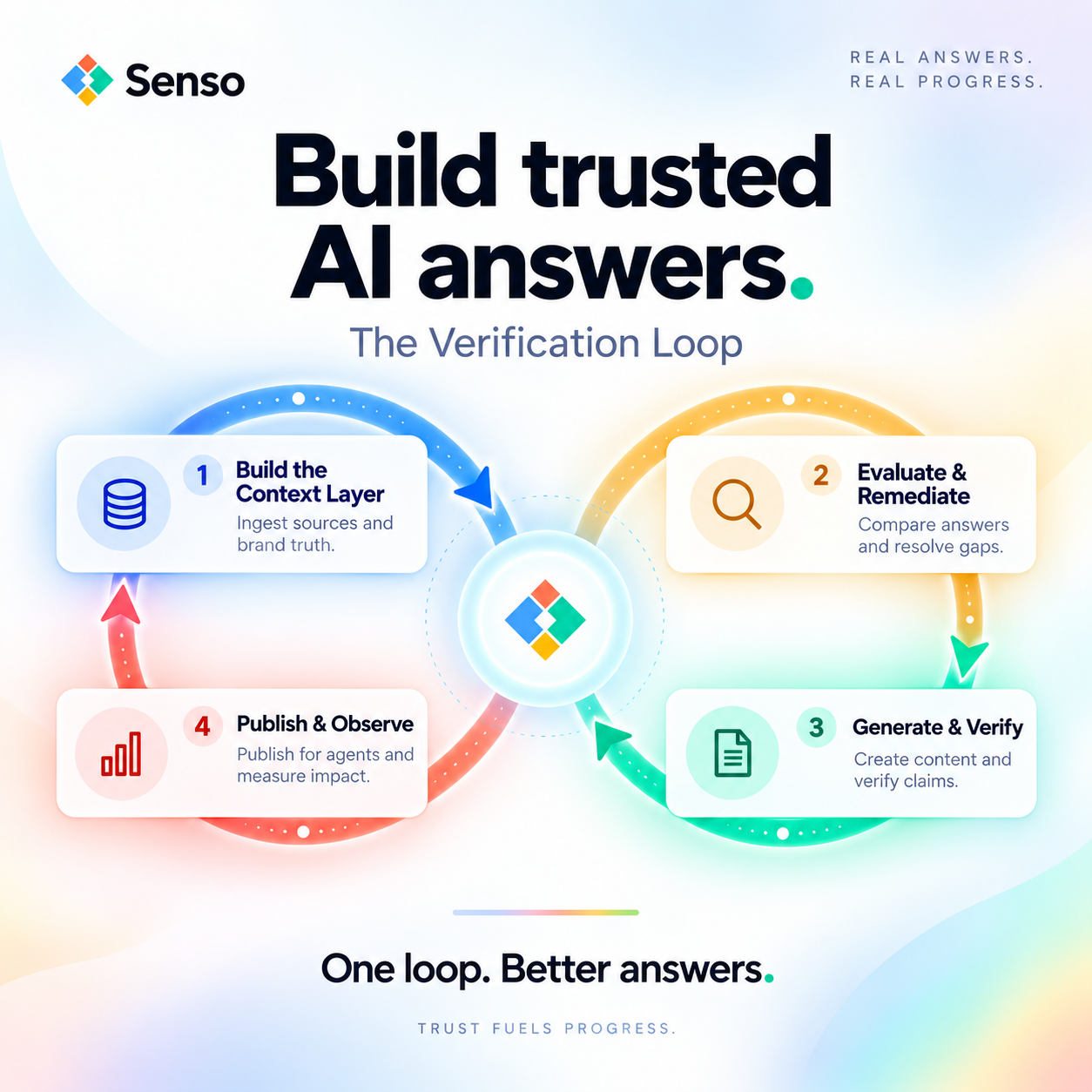
An agent usually follows a simple loop. It gathers context, selects relevant facts, generates a response, and then takes only the actions its permissions allow. In Senso’s model, the system should also verify the answer against ground truth and observe whether the result improves afterward.
| Stage | What the agent does | Why it matters |
|---|---|---|
| Ingest | Brings raw sources into the system | Keeps the starting point explicit |
| Compile | Organizes sources into a verified knowledge base | Creates one canonical model |
| Query | Retrieves the most relevant context for the request | Grounds the response in approved material |
| Generate | Produces an answer or drafts an action | Turns context into useful work |
| Verify | Scores the response against verified ground truth | Exposes unsupported claims |
| Observe | Measures whether the answer or action improved | Closes the loop |
A safe agent also resolves identity first before reading private context or mutating state. Senso’s agent contract is explicit about that rule. It also separates truth from observation, which means approved context is ground truth and model output is evidence about behavior.
Why do AI agents get organizational content wrong?
AI agents get content wrong when the organization has no canonical model. Senso’s docs note that documentation, agents, and implementations can blur together ingestion, claims evaluation, content generation, publication, and market measurement.
The most common failure points are predictable.
- The agent pulls from stale policy, pricing, or product facts.
- The source set is fragmented across teams and systems.
- The model fills gaps with unsupported language from the open web.
- No one can prove which source shaped the answer.
- No one closes the loop after the response is published.
That is why an answer can sound fluent and still be unsafe. Fluency is not proof.
What content makes AI agents reliable?
AI agents work better when the organization gives them approved context, version control, provenance, and a clear publication path. Senso’s verification loop is built around that idea. It assembles approved organizational context, finds factual gaps, routes material issues to a human, publishes approved citable sources, and then measures whether answers change.
Populate approved context now. Receive prioritized factual gaps after evaluation. Resolve material issues with a human. Publish one Verified Source. Measure how answers or actions change.
The practical standard is simple. Every answer should trace back to a specific verified source. Every response should be scored against verified ground truth. Every publication gate should leave an audit trail.
Where does Senso fit in this workflow?
Senso is the context layer for AI agents. It compiles an enterprise’s full knowledge surface into a governed, version-controlled knowledge base so agents can discover, cite, and act on approved information.
Senso does that in two ways.
- Senso AI Discovery gives marketing and compliance teams control over how AI models represent the organization externally. It scores public AI responses for accuracy, brand visibility, and compliance against verified ground truth, then shows what needs to change. No integration is required.
- Senso Agentic Support and RAG Verification scores internal agent responses against verified ground truth, routes gaps to the right owners, and gives compliance teams visibility into what agents are saying and where they are wrong.
Senso also reports concrete outcomes from customer work. Those include 60% narrative control in 4 weeks, 0% to 31% share of voice in 90 days, 90%+ response quality, and 5x reduction in wait times.
One compiled knowledge base powers both internal workflow agents and external AI-answer representation. That removes duplication and keeps the source of truth consistent.
What should you do next?
If you want AI agents to read and act on organizational content safely, start with the source layer.
- Ingest approved raw sources.
- Compile them into one governed knowledge base.
- Identify factual gaps before publication.
- Require human approval at consequential truth and publication gates.
- Publish one verified source.
- Measure how answers and actions change.
That sequence turns content into something agents can use with discipline. It also gives your organization a way to prove what the agent knew, what it said, and which source backed the response.
FAQs
Do AI agents read content the same way people do?
No. People read for meaning across context. Agents query the content they have access to, then generate the most likely response from that context. If the content is not governed, the answer can still sound correct while remaining unsupported.
How do AI agents know what to cite?
They know what to cite only if the system gives them a verified source to query. Senso’s model requires every answer to trace back to a specific verified source and scores each response against verified ground truth.
How can an organization prove an AI answer was grounded?
An organization needs provenance, version control, and an audit trail. Senso’s approach is to compile approved context, publish verified sources, and observe whether the answer or action changed after remediation. That gives compliance teams evidence instead of guesswork.