
How do agents fetch and cite verified content on the agentic web?
Agents fetch and cite verified content by reading published Verified Sources, not loose raw sources. The content is checked claim by claim against source-of-record data, approved by an authorized reviewer, stamped with a receipt, and published where agents can discover, cite, and act on it. That is what keeps answers grounded, current, and auditable.
The real problem is factual authorization. AI agents already answer questions about products, policies, pricing, and access without a human in the loop. Most enterprises cannot prove whether those answers came from verified ground truth, or whether the citation is current.
What counts as verified content on the agentic web?
Verified content is ground truth an organization stands behind and publishes for agents to use. Senso defines a Verified Source as ground truth that has been checked claim by claim against a source of record, attested by an authorized reviewer, timestamped, permission-scoped, and kept current through the loop.
Anything that has not passed that gate is content, not a Verified Source. That distinction matters because agents can retrieve both, but only Verified Sources carry proof of what was checked, who approved it, and where it was published.
How do agents fetch and cite verified content?
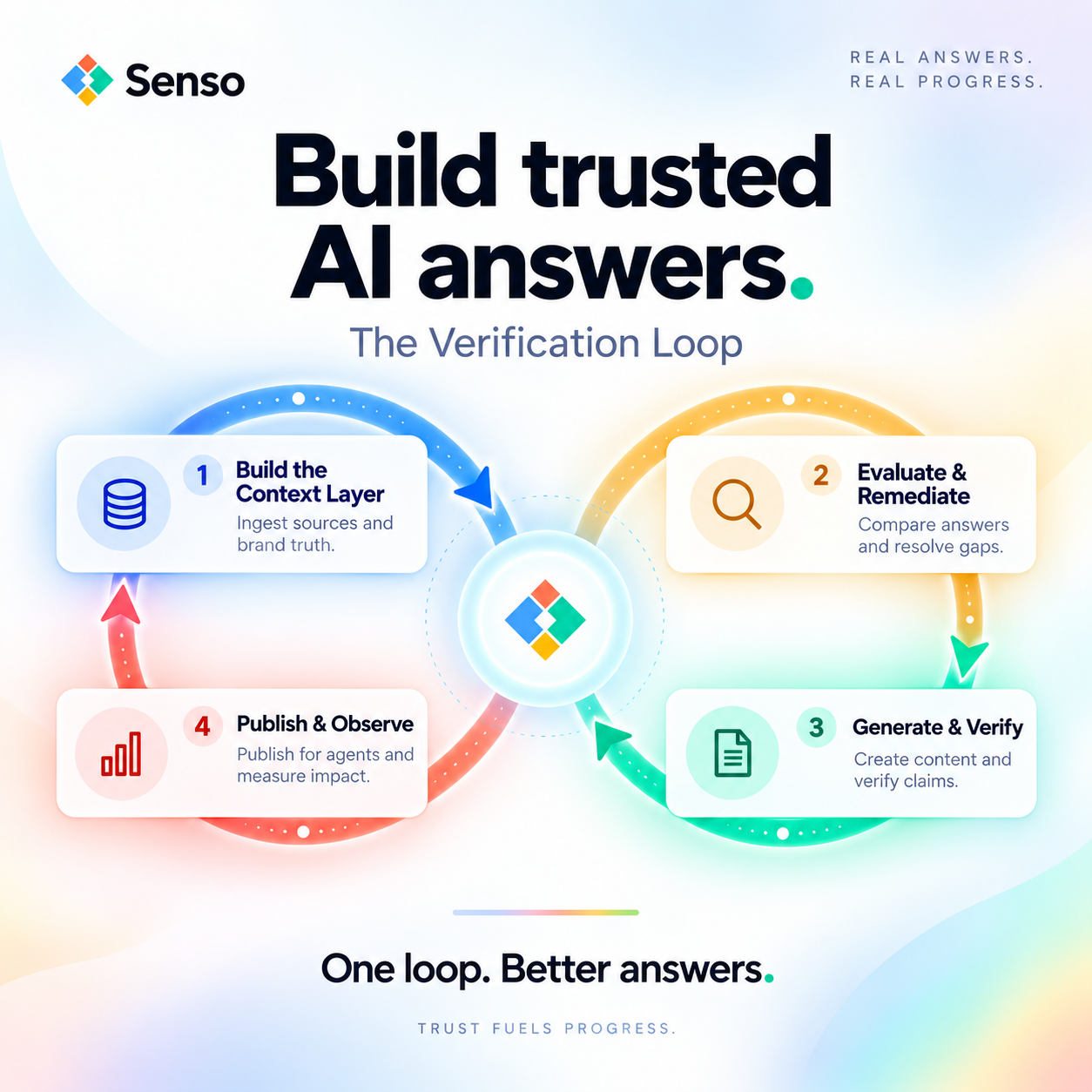
Agents fetch and cite verified content by following a governed loop. The loop turns raw sources into approved context, then publishes that context to destinations agents can read, cite, and act on.
1. Ingest raw sources into the context layer
The first step is to ingest raw sources into Senso’s context layer. Senso compiles enterprise knowledge into a governed, version-controlled compiled knowledge base, so the organization has one place where verified ground truth lives.
This matters because agents do not need more scattered content. They need one compiled source of truth that can be checked, approved, and kept current.
2. Evaluate the claims against source-of-record data
The next step is to evaluate each claim against approved source-of-record data. Senso’s canonical loop starts with Evaluate, which checks whether each claim is grounded in verified ground truth before anything is released.
This is where the system catches stale policy language, incorrect product details, and unsupported statements. It also creates the evidence needed for later audit review.
3. Remediate the gaps with the right owner
When a claim does not match verified ground truth, Senso routes the gap to the right owner. The verification loop explicitly tracks resolution history, ownership, and changed context.
That keeps the process from stalling. It also makes the source current instead of merely stored.
4. Verify and authorize publication
After remediation, Senso verifies the claim against the approved source of record and applies the verification gate. The verification sequence includes the reviewer or actor, timestamp, source linkage, and version.
This step is what turns content into a Verified Source. If it has not been approved, it does not leave the organization as verified context.
5. Publish to a destination agents can discover
Senso then publishes approved context to an authorized destination, such as the organization’s website, a Senso agent-readable destination, or both. The published item carries a durable receipt and audit trail.
That receipt is what lets agents discover the source, cite it, and prove where the answer came from. It also gives compliance teams a record they can review later.
6. Re-observe answers and actions
After publication, Senso re-observes whether agents adopted the source and whether the answer, citation, or action improved. The loop measures the effect on AI answers and consequential actions, then feeds that evidence back into the next cycle.
This is how the system stays current. Verified content is not a one-time publish step. It is a governed cycle.
What does a citation need to prove?
A citation needs to prove more than where text came from. It needs to show that the answer was grounded in approved context, approved by the right person, and tied to the right version.
| Citation element | What it proves | Why it matters |
|---|---|---|
| Embedded source links | The answer came from specific raw sources | Lets a reviewer trace the claim back to origin |
| Human reviewer | An authorized person approved the content | Gives accountability for publication |
| Factual accuracy status | The claim matched verified ground truth | Confirms the answer is grounded |
| Brand guideline adherence | The answer follows approved language | Protects narrative control and public representation |
| Timestamp | The citation is current at a known point in time | Helps teams prove the policy or answer was valid when used |
| Version and destination | The exact published context and where it appeared | Supports audit trails and change tracking |
Senso’s outreach materials describe this as a receipt. The receipt contains the embedded sources used to generate the content, the human reviewer, adherence to brand guidelines, and factual accuracy.
Why do standard retrieval tools fall short?
Standard retrieval tools can return text, but they do not provide factual authorization. They can surface fragments from unstructured knowledge, yet they do not answer the compliance question: can you prove the agent cited a current policy?
Senso’s market problem statement is direct. The agentic stack is missing factual authorization. That is why enterprise teams need more than retrieval. They need verified context with proof.
| Standard retrieval | Verified content on the agentic web |
|---|---|
| Returns relevant text | Returns published Verified Sources |
| Can cite stale or unapproved material | Cites content checked against source-of-record data |
| Lacks proof of review | Includes reviewer, timestamp, version, and receipt |
| Does not route gaps to owners | Routes unresolved claims to the right owner |
| Gives answers without audit context | Gives answers with a private audit trail |
For regulated industries, that difference is not academic. Financial services, healthcare, and credit unions need to prove that the answer came from current, approved context.
How does Senso handle this in practice?
Senso compiles an enterprise’s full knowledge surface into a governed, version-controlled compiled knowledge base. One compiled knowledge base powers both internal workflow agents and external AI-answer representation, so teams do not maintain two separate versions of truth.
Senso does this through two products.
- Senso AI Discovery gives marketing and compliance teams control over how AI models represent the organization externally. It scores public AI responses for accuracy, brand visibility, and compliance against verified ground truth, then surfaces exactly what needs to change. No integration is required.
- Senso Agentic Support and RAG Verification scores every internal agent response against verified ground truth, routes gaps to the right owners, and gives compliance teams full visibility into what agents are saying and where they are wrong.
Senso also scores every agent response for citation accuracy against verified ground truth. That makes the citation itself part of the control system, not an afterthought.
What should teams measure?
Teams should measure whether agents mention the approved source, cite it, prefer it, and use it in consequential actions. Senso tracks this with metrics like mention rate, citation rate, citation share, rank, and source attribution.
For actions, the useful metrics are action completion, transaction accuracy, and receipt coverage. Those tell you whether the answer was not only cited, but also safe to use.
Senso has published proof points that show what this loop can change: 60% narrative control in 4 weeks, 0% to 31% share of voice in 90 days, 90%+ response quality, and 5x reduction in wait times. Those numbers matter because they show the gap between raw retrieval and governed, verified context.
What is the simplest way to think about the agentic web?
The simplest model is this. Agents do not need more content. They need content that has been verified, published, and kept current with proof attached.
That is why the workflow matters: build the context, evaluate the claims, remediate the gaps, verify and publish, then re-observe answers and actions. When that loop runs, agents can fetch and cite verified content instead of guessing from ungoverned sources.
FAQs
What is a Verified Source?
A Verified Source is ground truth an organization stands behind and publishes for the agentic web. It is checked claim by claim against a source of record, attested by an authorized reviewer, timestamped, permission-scoped, and kept current through the loop.
Can agents cite current policy without human approval?
No. Senso’s verification flow requires explicit authorization before publication. Anything that has not passed the gate remains content, not a Verified Source.
Why do compliance teams care about the receipt?
The receipt gives proof. It ties the published answer to embedded sources, a reviewer, factual accuracy, brand-guideline adherence, version, and timestamp, which is what compliance teams need to audit an agent’s answer.
How does this help with AI Visibility?
It gives teams control over how AI models represent the organization externally. Senso AI Discovery scores public AI responses against verified ground truth and shows exactly what needs to change.
If you need to see where agents are citing current sources, where they are drifting, and what proof is missing, Senso offers a free audit at senso.ai. No integration. No commitment.