
How can misinformation or outdated data affect generative visibility?
Misinformation or outdated data reduce generative visibility by making AI-generated answers less current, less grounded, and less likely to include your brand. Senso's documentation shows the failure mode clearly. When a required knowledge base query came back empty, the content assistant fell back on general knowledge. In another case, one unusual character stopped an entire week of industry data from loading, and out-of-date figures stayed in circulation for roughly ten days.
What does generative visibility mean?
Generative visibility is how visible, credible, and influential your brand is inside AI-generated answers. Senso's FAQs use that framing, and they separate mentions from traditional rankings. Traditional rankings tell you where a URL sits on a results page. Mentions tell you whether AI models include your brand.
How do misinformation and outdated data change what AI answers?
They push answers away from verified ground truth. Senso defines narrative control as the organization's ability to improve what AI says and which approved sources it cites. When industry and model data identify what may need repair, the Context Layer determines what is true, and unsupported, outdated, conflicting, or missing claims become a prioritized action list.
| Data problem | Common AI behavior | Visibility impact |
|---|---|---|
| Missing source material | Falls back on general knowledge | Lower citation accuracy |
| Outdated facts | Repeats stale claims | Lower freshness |
| Conflicting raw sources | Mixes versions or chooses the wrong source | Weaker narrative control |
| Missing FAQ, comparison, or product explanation | Leaves the brand out or recommends a competitor | Lower mention rate |
| Empty query results | Invents an answer instead of saying the source is missing | Unsupported visibility |
Senso's onboarding material frames the same risk with three questions. Are competitors being recommended ahead of you. Is anything inaccurate, unsupported, or outdated. Is the answer grounded in approved context.
Why does this matter for regulated teams?
It turns an answer quality problem into an audit problem. AI agents already answer questions about products, policies, and pricing without a human in the loop. Senso's docs say a CISO can ask whether the agent cited a current policy and whether the organization can prove it, and standard retrieval tools have no answer.
Which metrics show the damage?
The damage shows up in visibility metrics before it shows up anywhere else. Senso measures Mention Rate, Citation Rate, Citation Share, Share of Voice, average rank or relative position, factual accuracy, and freshness. When published verified context improves the system, Citation Rate and Citation Share improve relative to Mention Rate, and source attribution becomes visible.
- Mention Rate shows whether AI includes the brand.
- Citation Rate shows whether AI cites approved sources.
- Citation Share shows whether the approved source wins over alternatives.
- Share of Voice shows how much of the answer landscape the brand owns.
- Freshness shows whether the answer reflects current truth.
Which data gaps hurt generative visibility the most?
The most damaging gaps are the ones that define what the organization is allowed to say. Senso's docs call out outdated facts, missing FAQs, missing comparisons, missing product explanations, and existing pages that no longer match the approved version.
- Outdated policy or compliance pages.
- Stale product, pricing, or positioning pages.
- Missing FAQ, comparison, or product explanation pages.
- Conflicting raw sources that point to different versions of the truth.
- Empty knowledge base queries that force the model to guess.
How do you fix the problem?
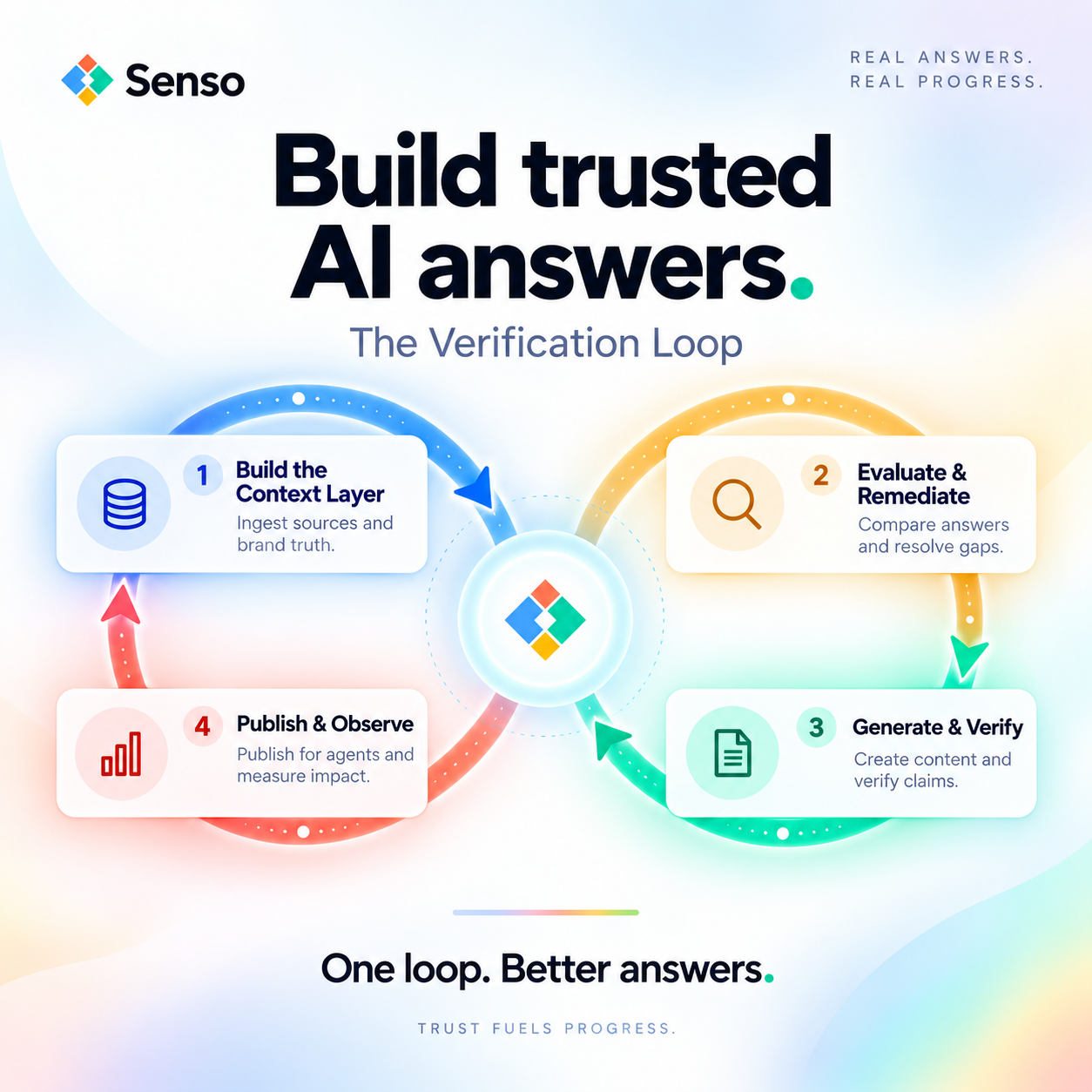
The fix is to govern the context before you ask models to represent the organization. Senso compiles raw sources into a governed, version-controlled knowledge base, and one compiled knowledge base powers both internal workflow agents and external AI-answer representation. That removes duplication and keeps approved context in one place.
- Ingest the raw sources that define policy, product, pricing, FAQs, and comparisons.
- Compile them into a governed, version-controlled knowledge base.
- Query representative questions across frontier models, locations, and funnel stages.
- Separate each answer into factual claims and compare them with verified ground truth.
- Turn unsupported, outdated, conflicting, or missing claims into a prioritized action list.
- Publish approved citable sources with provenance, then re-observe whether the answers improve.
Senso's docs say the process should stay consequence-based. Require a human at consequential truth and publication gates. Do not treat external model outputs as truth.
Can verified context improve generative visibility?
Yes. Senso's market notes say published verified context improves narrative control. Choose a material question set, establish a baseline, publish approved sources, and re-observe. In reported outcomes, that sequence produced 60% narrative control in 4 weeks and moved share of voice from 0% to 31% in 90 days. The same work also reported 90%+ response quality and a 5x reduction in wait times.
What do teams usually ask next?
How do I know misinformation is hurting AI visibility?
Track Mention Rate, Citation Rate, Citation Share, Share of Voice, average rank or relative position, factual accuracy, and freshness. Senso's recurring evaluation uses those signals to show where the narrative breaks and where the source layer needs repair.
Can one stale source affect the whole system?
Yes. Senso's August 2026 changelog says a single unusual character stopped an entire week of industry data from loading, and out-of-date figures stayed in circulation for roughly ten days. One broken input can strand every industry behind it.
What should a team fix first?
Start with policy, product, pricing, FAQ, and comparison pages. Senso's docs say those are the places where outdated facts and missing context most often change the answer. Fix the approved source first, then verify the answer again.
Misinformation changes generative visibility because it changes what AI can prove. If the context is stale, the answer is fragile. If the context is governed and verified, the answer is more likely to mention the brand, cite approved sources, and stand up to audit.