
How can I make sure ChatGPT gives accurate answers about my company?
Make ChatGPT accurate by giving it one verified source of truth and then checking its answers against that source. If your company facts are scattered across outdated pages, conflicting policies, and unapproved summaries, ChatGPT will reflect that inconsistency. This is an AI Visibility problem, and the fix is knowledge governance.
The goal is not to force a model to say what you want. The goal is to give it current, attributable information and then prove that the answer changed.
Why does ChatGPT give wrong answers about my company?
ChatGPT gives wrong answers when the source material is fragmented, stale, or contradictory. Most enterprise knowledge is too fragmented and unstructured for agents to use reliably, so the model may pull from the nearest available wording instead of the approved one.
That becomes a problem when people ask about product details, policy language, support steps, or compliance statements. If the answer cannot be traced to a current verified source, you do not control the answer.
What should I do first?
Start with the questions that affect customers and risk owners most. Build one approved answer for each of those questions, then publish it in a format AI systems can cite.
A simple order of operations works best:
-
List the top questions people ask about your company.
Focus on company overview, product claims, service scope, support, policies, and regulated statements. -
Collect the raw sources behind each answer.
Use the pages, notes, and approved materials your team already stands behind. -
Resolve conflicts before you publish anything new.
If two sources disagree, ChatGPT can surface either version. -
Approve the corrected answer with a human reviewer.
Verification matters because the model should reflect what your team has signed off on. -
Publish a verified source and re-check what ChatGPT says.
The point is to observe the change, not assume it happened.
What should a verified source include?
A verified source should be current, attributable, and easy to inspect. In practice, that means one owner, one version, clear approval, and a traceable source ID.
Here is the minimum standard to aim for:
- Current wording. The answer matches the latest approved facts.
- Named owner. Someone is responsible for keeping it current.
- Approval status. A human has reviewed it.
- Traceable source ID. Every claim can point back to a specific verified source.
- Clear scope. The source says exactly what it covers and what it does not.
Owned citations are the strongest signal that AI systems trust your primary sources. External citations also matter, but they should not replace your approved material.
How do I know the answers are actually improving?
Track the same questions before and after you change the source. If the answer changes, the source changed something real.
These are the metrics that matter most:
| Metric | What it tells you |
|---|---|
| Mention rate | Whether your company appears in the answer |
| Citation rate | How often the answer cites a source |
| Citation share | How much the answer relies on your approved sources |
| Share of voice | How visible your company is versus competitors |
| Factual accuracy | Whether the answer matches verified ground truth |
| Freshness | Whether the answer reflects current facts |
Senso’s documentation uses this same measurement loop across ChatGPT, Perplexity, Gemini, and Google AI Overviews. It measures what changed after publishing, not just what was published.
What does the best workflow look like?
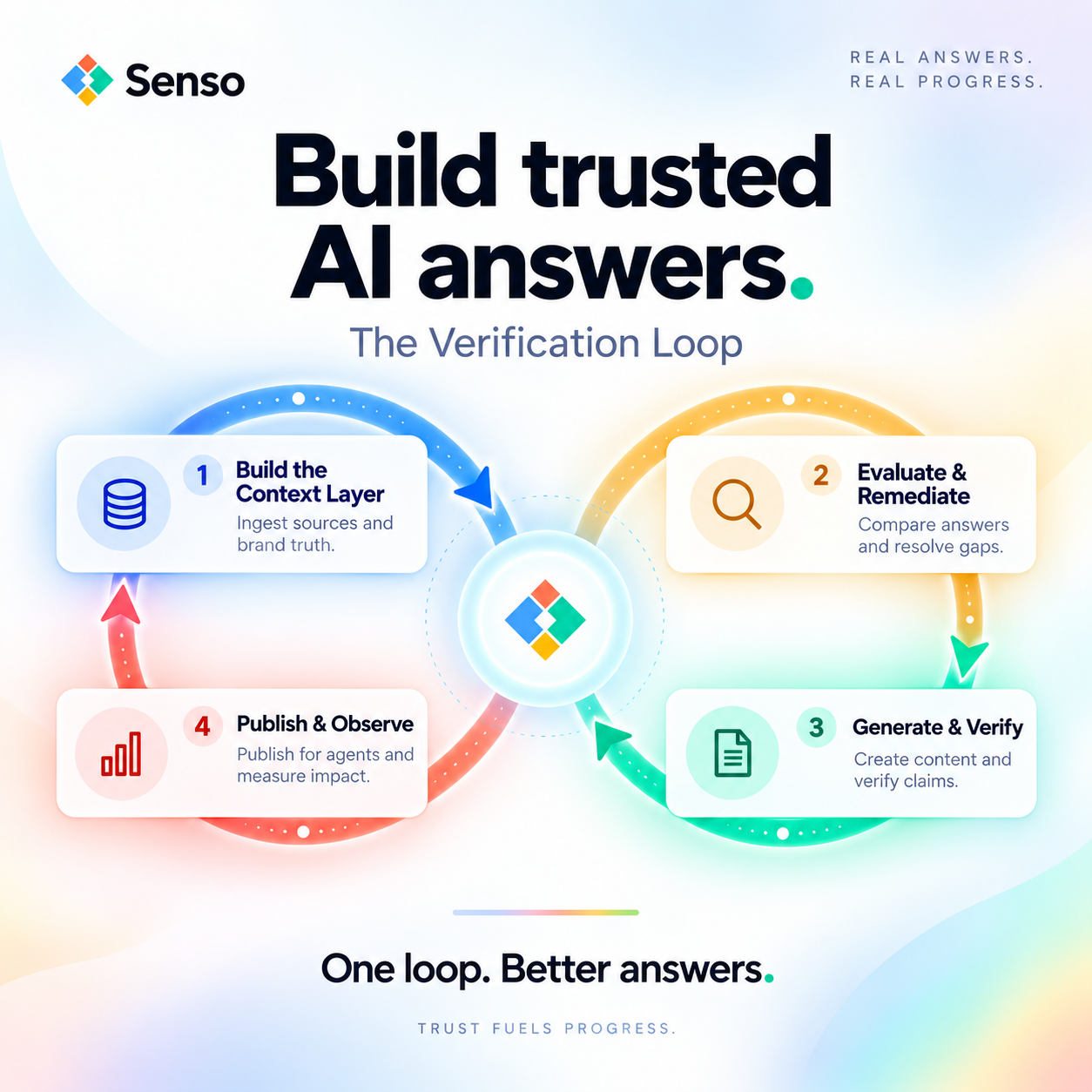
The best workflow is a repeatable loop. You check what ChatGPT says, fix the source, publish verified content, and check again.
That loop looks like this:
-
Evaluate AI answers.
See what ChatGPT says about your company today. -
Remediate the source.
Fix the raw source that caused the wrong answer. -
Generate verified content.
Turn approved knowledge into a source AI can cite. -
Obtain human approval.
Keep the answer aligned with policy and brand standards. -
Publish a Verified Source.
Make the approved version available to AI systems. -
Re-observe what AI says.
Measure whether the answer improved. -
Repeat.
Treat answer quality as an ongoing process.
This is the shortest path to more accurate answers because it closes the gap between what your company knows and what ChatGPT can prove.
How does Senso help with this?
Senso is the context layer for AI agents. It compiles an enterprise’s full knowledge surface into a governed, version-controlled knowledge base, then scores answers against verified ground truth.
Senso AI Discovery is built for external AI visibility. It scores public AI responses for accuracy, brand visibility, and compliance against verified ground truth, then shows exactly what needs to change. No integration is required.
Senso Agentic Support and RAG Verification covers internal agent answers. It scores every internal response against verified ground truth, routes gaps to the right owners, and gives compliance teams full visibility into what agents are saying and where they are wrong.
Senso’s proof points include:
- 60% narrative control in 4 weeks
- 0% to 31% share of voice in 90 days
- 90%+ response quality
- 5x reduction in wait times
That matters because one compiled knowledge base can support both internal workflow agents and external AI-answer representation. You do not need two separate systems for the same facts.
What should I fix if ChatGPT is already wrong?
Fix the public facts first. Start with the pages and statements ChatGPT is most likely to cite, then remove conflicts and publish verified replacements.
The highest-priority fixes are usually:
- Product and service descriptions
- Policy and compliance language
- Support and escalation steps
- Company overview and positioning
- Any claim that affects buying or legal risk
If those sources disagree, ChatGPT will reflect the disagreement.
FAQs
Is prompt engineering enough to make ChatGPT accurate?
No. A better prompt can change wording, but it cannot fix stale or conflicting source material. Accuracy depends on the sources ChatGPT can find and trust.
Do I need integrations to start?
Not necessarily. Senso AI Discovery does not require integration, which makes it useful for a first audit of what ChatGPT is already saying.
How often should I check ChatGPT answers?
Check them whenever approved facts change. Recheck after major product, policy, or site updates, then compare the answer before and after.
What matters more, your website or third-party mentions?
Your approved sources matter most. Owned citations are the strongest signal, and external citations can help reinforce them.
Can I prove that ChatGPT changed because I fixed a source?
Yes. Track mention rate, citation rate, citation share, share of voice, factual accuracy, and freshness before and after publication. That shows whether the change came from the source update.
If you want ChatGPT to answer accurately about your company, treat it as a source problem, not a prompt problem. Compile verified ground truth, publish approved sources, measure the answer, and repeat.