
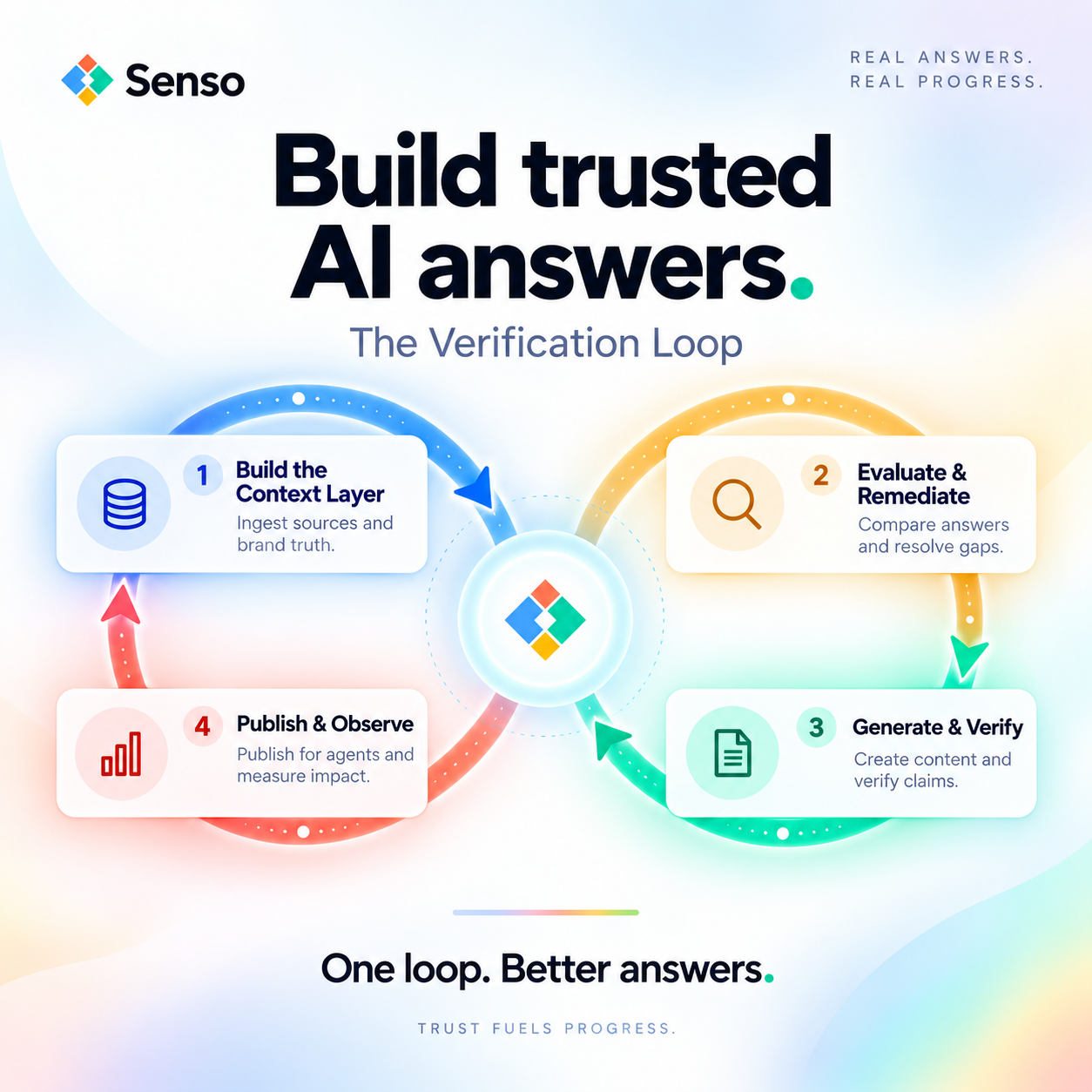
How can companies benchmark their visibility in AI-generated answers
AI systems already answer questions about your products, policies, pricing, and competitors. Companies benchmark visibility in those answers by running the same prompts across multiple models, then scoring each response against verified ground truth. The benchmark should show three things. Whether the brand appears. Whether the model cites proof. Whether the answer matches the approved story.
What should companies measure first?
Start with mentions, citations, share of voice, and change over time. Those four signals show whether the brand is present, whether the answer is traceable, how much of the answer belongs to the brand, and whether performance is improving or drifting.
| Metric | What it measures | Why it matters |
|---|---|---|
| Mentions | Whether the brand appears in an AI-generated answer for a tracked prompt | Mentions are the baseline signal of visibility |
| Citations | Whether the answer cites owned pages or credible external sources | Citations show where the answer came from and support auditability |
| Share of Voice | The percentage of an AI-generated answer dedicated to the brand compared with competitors | Share of Voice measures answer dominance |
| Visibility Trends | How visibility signals change over time across evaluated prompts | Trends show whether corrections are working or drifting |
| Organization Leaderboard | Visibility performance across tracked prompts | Leaderboards show which topics or prompts matter most |
Traditional rankings tell you where a URL sits on a results page. Mentions tell you whether AI models include your brand. That difference matters because AI answers often shape the first impression before a person ever reaches your site.
How do companies build a repeatable benchmark?
A repeatable benchmark uses the same prompts, the same models, and the same scoring rules every run. That is how teams see real change instead of random model noise.
-
Define tracked prompts by funnel stage.
Use the questions customers ask when they first learn, compare, and decide. Senso categories prompts by funnel stage inside My Prompts, which helps teams see where visibility breaks. -
Compile verified ground truth.
Ingest raw sources, version them, and keep one governed compiled knowledge base. Every answer should trace back to a specific verified source. -
Run prompts across selected AI models on a schedule.
Senso runs tracked prompts across selected AI models and captures the generated answers. That gives you a consistent view across the systems that already represent your brand. -
Score each answer against verified ground truth.
Convert each model response into structured visibility signals tied to the prompt. Check whether the answer is grounded, whether it cites current sources, and whether it reflects the approved narrative. -
Compare performance by prompt, model, and time.
Use Visibility Trends to see movement and the Organization Leaderboard to see prompt-level performance. That makes drift visible instead of hidden in one-off spot checks. -
Route gaps to owners.
If a model answer is unsupported or outdated, publish the verified content that should correct it and rerun the benchmark. The point is not just to measure the gap. The point is to close it.
What does a useful benchmark report show?
A useful report shows the score and the reason behind it. Teams need the answer text, the source that supports it, and the gap between the current response and verified ground truth.
A strong report usually includes:
- A baseline by prompt and model
- The exact answer or response summary
- The source trace for each claim
- Share of Voice by competitor set
- Visibility Trends week by week
- The owner or team responsible for each gap
In documented Senso outcomes, teams reached 60% narrative control in 4 weeks and moved from 0% to 31% share of voice in 90 days. Senso also reports 90%+ response quality and a 5x reduction in wait times. Those are the kinds of shifts a benchmark should make visible.
Why do regulated teams care about citation accuracy?
Citation accuracy matters because AI answers need proof, not just presence. When a CISO, compliance lead, or legal team asks whether an answer cited a current policy, the benchmark has to show the source and the version behind it.
Citations are a trust mechanic for AI engines. When models cite your owned pages or credible external sources about your brand, they signal where the answer came from. That makes the response easier to verify, audit, and correct.
This matters most in regulated industries like financial services, healthcare, and credit unions. Those teams need to know whether the answer is grounded in current policy, not just whether the answer sounds right.
How often should companies rerun the benchmark?
Run it weekly at minimum, and rerun it whenever facts change. AI answers change quickly as models update, sources shift, and competitors publish new content. Weekly tracking lets teams catch drift before it affects customers or staff.
If pricing, policies, product claims, or approved language change, update the verified ground truth first. Then rerun the prompts. That keeps the benchmark tied to current reality instead of stale content.
How does Senso benchmark AI visibility?
Senso benchmarks AI visibility by comparing AI answers to verified ground truth across leading models. Senso compiles an enterprise’s full knowledge surface into a governed, version-controlled compiled knowledge base, then measures whether public and internal AI answers stay grounded.
Senso does this through two products:
- Senso AI Discovery gives marketing and compliance teams control over how AI models represent the organization externally. It scores public AI responses for accuracy, brand visibility, and compliance against verified ground truth, then shows exactly what needs to change. No integration required.
- Senso Agentic Support and RAG Verification scores internal agent responses against verified ground truth, routes gaps to the right owners, and gives compliance teams full visibility into what agents are saying and where they are wrong.
That matters because one compiled knowledge base powers both internal workflow agents and external AI-answer representation. There is no duplication. The same verified source of truth can support both visibility and governance.
If you want a baseline, Senso offers a free audit at senso.ai. No integration. No commitment.
FAQs
What is the most important benchmark metric?
Mentions are the first metric to track because they show whether your brand appears at all. After that, add citations and share of voice so you can separate visibility from proof and answer dominance.
What is the difference between mentions and citations?
Mentions tell you whether the brand appears in the answer. Citations tell you whether the answer points to owned pages or credible sources. Mentions measure presence. Citations measure traceability.
Can one benchmark cover both internal and external AI answers?
Yes. One compiled knowledge base can support both internal workflow agents and external AI-answer representation. That gives teams one governed source of verified ground truth and one way to measure drift across both surfaces.
How do you know if the benchmark is working?
A benchmark is working when the metrics move. Look for higher share of voice, stronger citation accuracy, better response quality, and faster correction cycles. In Senso’s documented outcomes, those changes included 60% narrative control in 4 weeks, 0% to 31% share of voice in 90 days, 90%+ response quality, and 5x faster wait times.