
How are LLMs changing how people discover brands?
LLMs are changing brand discovery by replacing the results page with a synthesized answer. People now ask a model for the best option, a comparison, or a policy answer, and the model decides which brands get named, cited, or left out. That shifts visibility from ranking pages to being represented correctly inside the answer.
For brands, the new question is not just whether people can find you. It is whether an AI system can describe you accurately, cite a current source, and keep doing that as answers change. In regulated industries, the bar is higher. Teams need proof that the answer came from verified ground truth and an authorized source.
What is changing in brand discovery?
Brand discovery is moving from browsing links to asking questions. That changes how people evaluate brands, because the model does the comparing before the person ever reaches a website.
| Old discovery | LLM-driven discovery |
|---|---|
| People scan a results page | People ask one question |
| Brands compete for rankings | Brands compete to be named in the answer |
| Success is measured by clicks | Success is measured by mentions, citations, and representation |
| Content can sit in many places | A few verified sources can shape the answer |
This shift matters because AI discovery is moving from links to synthesized answers. When that happens, the model becomes the first filter between a brand and the buyer.
Why does this matter for brands?
LLMs are becoming the interface between businesses and customers. People ask AI systems what to buy, who to trust, and how to compare options, and the answer often arrives before a search click ever happens.
That changes the job of brand content. The goal is no longer only to attract visits. The goal is to make sure the model can find, trust, and repeat the right facts about the brand.
Traditional rankings still matter, but they do not show whether AI includes your brand in the answer. Mentions, citations, and answer quality now tell a different story.
What makes a brand show up in AI answers?
LLMs tend to favor facts that reduce uncertainty. They work best when the source material is specific, consistent, and current.
The strongest signals are straightforward:
- Verified ground truth. The brand needs a short, factual source of truth that the model can rely on.
- Consistent naming. Product names, policy names, and company names need to match across sources.
- Clear source structure. A model can cite what it can parse. Direct statements help.
- Current facts. If pricing, policy, or product details change, the source has to change too.
- Coverage of obvious questions. If the source does not answer the next question, the model may go elsewhere.
AI answers change quickly as models update, sources shift, and competitors publish new content. That is why a one-time content update is not enough.
How should brands respond?
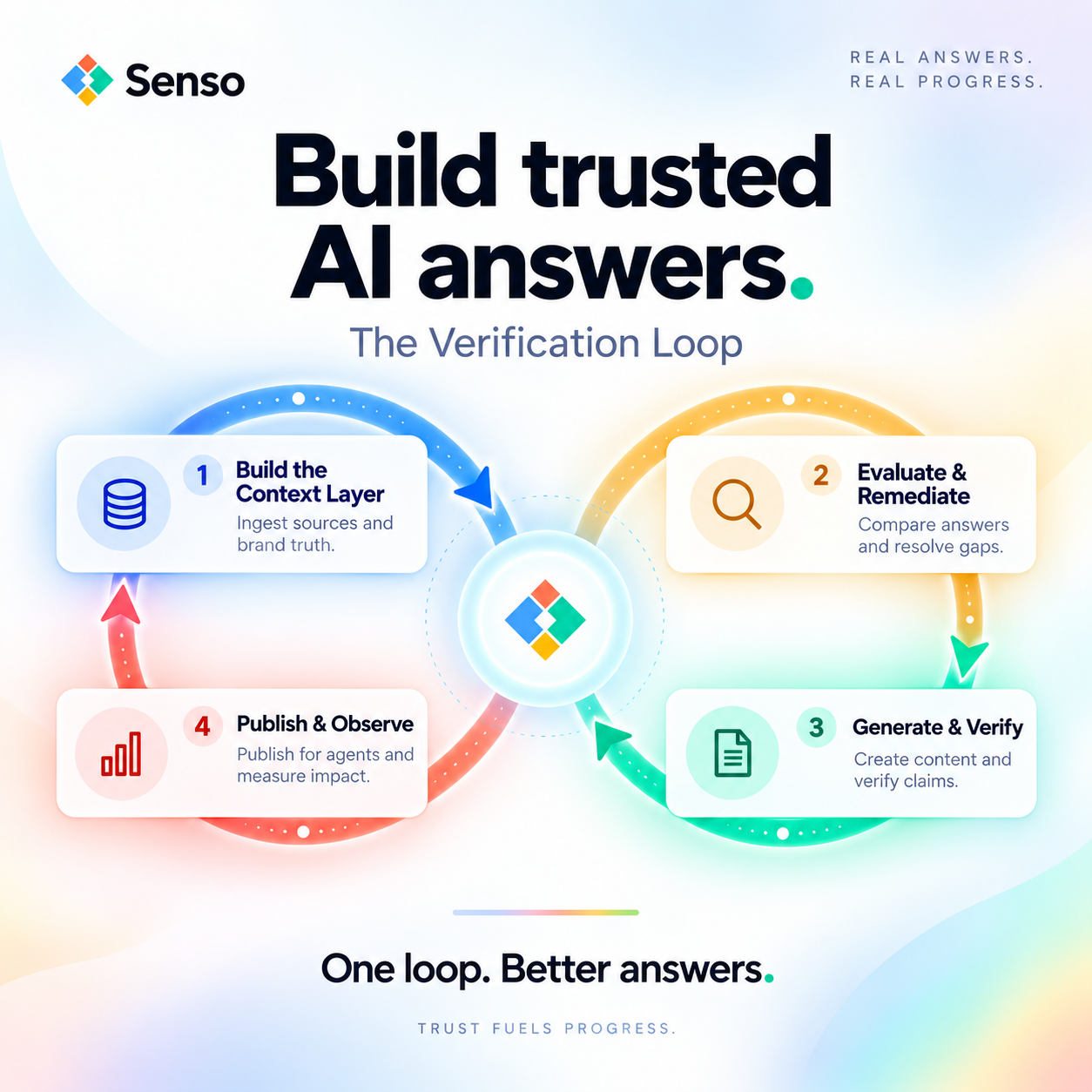
Brands should treat AI visibility as a governance problem, not just a content problem. The work starts with the facts, then moves to how those facts are presented and verified.
-
Compile verified ground truth.
Start with the facts that matter most. Product details, policies, positioning, and regulated claims belong in one governed knowledge base. -
Use the same canonical names everywhere.
Keep brand, product, and policy naming consistent across site pages, help content, and public materials. Inconsistency makes answers harder to ground. -
Make source pages easy to cite.
Use plain language and direct statements. Short factual sections are easier for models to represent than scattered claims. -
Track AI visibility across prompts and models.
Ask the questions customers ask. Review whether the brand is mentioned, whether the citation points to the right source, and whether the answer is current. -
Fix the source, not only the output.
If an answer is wrong, the problem usually starts in the underlying material. Update the raw sources, then check whether the answer changes.
This approach also reduces duplication. One compiled knowledge base can support both internal assistants and external AI answer representation.
What changes for regulated industries?
Regulated teams need more than visibility. They need proof.
If a model states a policy, a price, or a compliance claim, the organization needs to show which authorized source backed that answer and whether it was current at the time of use. Standard retrieval alone does not solve that problem.
That is why knowledge governance matters. Finance, healthcare, and credit unions have more at stake when a model cites the wrong policy or omits a required disclaimer. The issue is not only misrepresentation. It is auditability.
What should teams measure?
AI visibility metrics should show how visible, credible, and influential a brand is inside AI-generated answers. The core measures are simple.
- Mentions. Does the model include the brand at all?
- Citations. Does the answer point to a verified source?
- Accuracy. Does the answer match verified ground truth?
- Share of voice. How often does the brand appear relative to competitors?
- Response quality. Does the answer stay grounded when the question changes?
These measures give teams a better read on how AI systems represent the brand. They also show where the source material is weak.
What is the bottom line for brand teams?
LLMs are changing discovery from a page-ranking problem into an answer-quality problem. Brands now have to win the answer itself, not just the click.
That means the most reliable brands will be the ones with verified ground truth, consistent naming, and traceable sources. In a world where AI systems speak for the brand before a human does, the brand that controls its facts controls its representation.
FAQs
What is AI visibility?
AI visibility is how visible, credible, and influential a brand is inside AI-generated answers. It shows whether a model names the brand, cites the right source, and describes it correctly.
Are LLMs replacing search?
No. They are changing the first place people go for answers. Search still matters, but many discovery journeys now start with a question to an AI system.
Why do citations matter so much?
Citations show where the answer came from. For brands and regulated teams, they also make it possible to check whether the claim was grounded in verified ground truth.
What is the biggest risk if brands ignore LLM discovery?
The biggest risk is misrepresentation. If the model fills gaps with incomplete, outdated, or competing information, customers may see the wrong brand, the wrong claim, or the wrong policy.
How do brands improve their representation in LLMs?
They should compile verified ground truth, keep naming consistent, publish source-friendly content, and monitor how models answer the questions that matter most. The source needs to be clear before the answer can be correct.