
Can schools or universities optimize how AI describes their programs?
Yes. Schools and universities can improve how AI describes their programs, but this is not classic search marketing. It is a representation problem. AI answers drift when catalog pages, admissions rules, tuition details, and policy pages do not match.
Quick Answer
Yes. Schools and universities can improve how AI describes their programs by compiling a governed, version-controlled knowledge base, keeping public pages current, and scoring generated answers against verified ground truth. Senso AI Discovery does this for external AI Visibility without integration. In Senso deployments, teams reached 60% narrative control in 4 weeks and 0% to 31% share of voice in 90 days.
What does it mean to improve how AI describes academic programs?
AI Visibility is a knowledge governance practice that helps schools control how generated answers describe their programs. It matters because students, parents, and counselors now query AI tools about degrees, admissions, financial aid, and outcomes before they open a website.
The goal is not to force every model to say the same thing. The goal is to make sure the answer traces back to current, citation-accurate source material.
Why do AI answers about schools go wrong?
AI answers go wrong when the source material is fragmented. One page says one thing, an old PDF says another, and the admissions site uses different names or dates.
Most knowledge environments break down the same way. They are too fragmented and unstructured for agents to use reliably, especially when program details change across terms, departments, and policy updates.
What should schools and universities fix first?
Start with the facts AI uses most often. That usually means program names, degree formats, admissions criteria, tuition references, outcomes language, and policy details.
| Problem | What AI sees | What to do |
|---|---|---|
| Conflicting program names | Multiple versions of the same program | Standardize one canonical name |
| Stale admissions rules | Old policy language | Version-control approvals and updates |
| Scattered raw sources | Inconsistent facts across pages | Compile one governed source of truth |
| Missing citations | Ungrounded answers | Score answers against verified ground truth |
| No visibility into model output | Unknown external narrative | Audit AI answers regularly |
How can schools and universities improve how AI describes their programs?
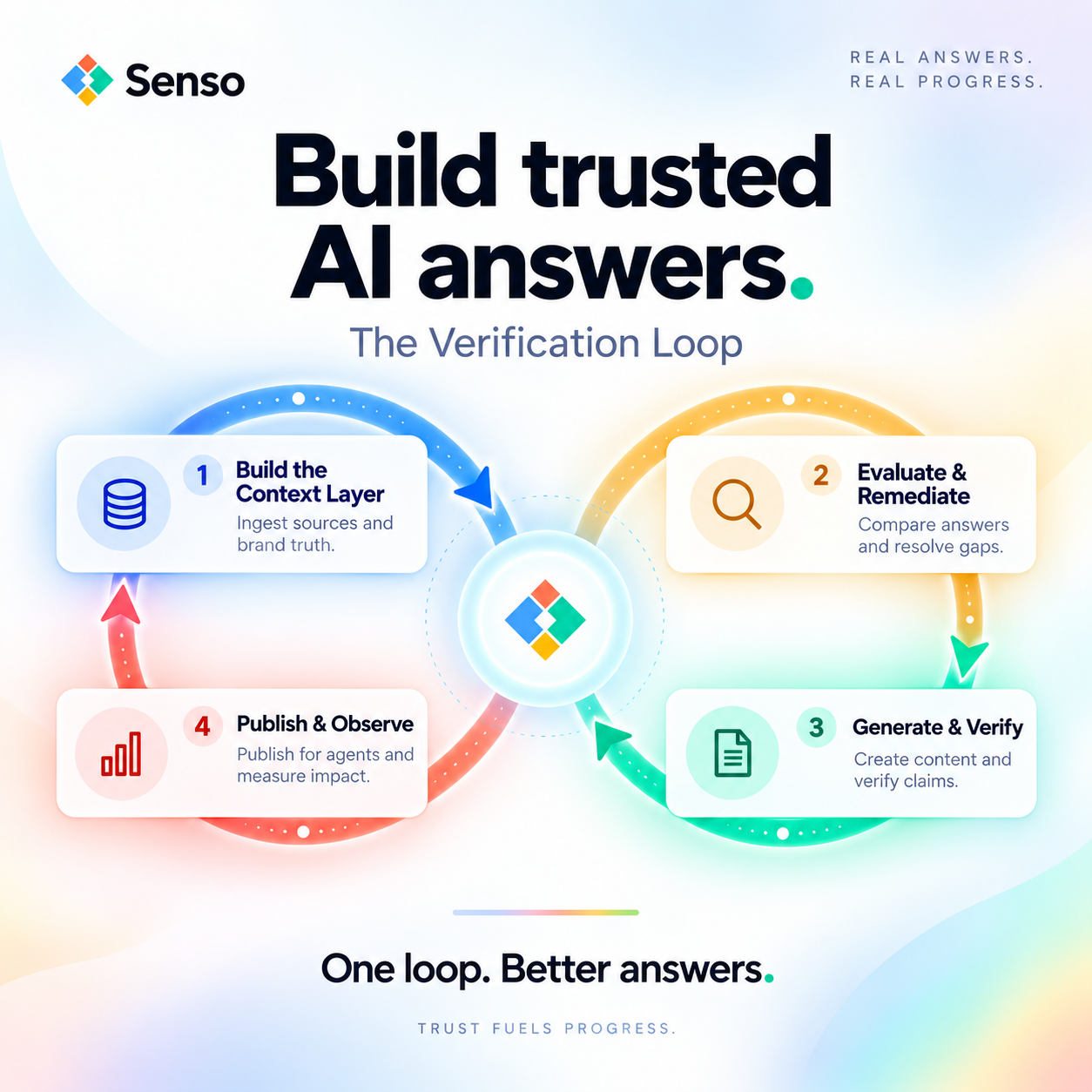
The work follows a clear sequence. The strongest results come from controlling the source material first, then measuring the answers.
-
Compile one verified source for each program.
Ingest raw sources from academic affairs, admissions, compliance, and marketing, then compile them into a governed knowledge base. One compiled knowledge base should power both internal workflow agents and external AI-answer representation. -
Use canonical naming everywhere.
Program names, degree labels, and specializations should match across the website, catalog, admissions pages, and policy pages. If the institution uses three names for one program, AI will repeat all three. -
Keep policy language current.
Admissions deadlines, tuition references, accreditation statements, and financial aid details change. Version control matters because outdated policy language is the fastest way to produce wrong answers. -
Score AI answers against verified ground truth.
Do not stop at traffic or visibility checks. Measure whether the answer is grounded, whether it cites the right source, and whether it matches the institution’s approved language. -
Route gaps to the right owner.
If the answer is wrong, fix the source, not just the response. Marketing, admissions, academic affairs, and compliance each need clear ownership. -
Recheck after every material change.
A catalog update, policy change, or new program launch can change how AI describes the institution. Re-query the major answer surfaces after every update.
What should schools measure?
Measure the quality of the answer, not just whether the page ranks.
| Metric | What it shows |
|---|---|
| Citation accuracy | Whether AI uses verified sources |
| Narrative control | Whether AI describes the institution the way it intends |
| Share of voice | How often the institution appears in generated answers |
| Response quality | Whether the answer is usable and grounded |
Senso deployments show what progress can look like. Teams reached 60% narrative control in 4 weeks, 0% to 31% share of voice in 90 days, and 90%+ response quality. Those are the right kinds of signals for schools that need proof, not guesswork.
Where does Senso fit?
Senso is the context layer for AI agents. For schools and universities, Senso AI Discovery helps marketing and compliance teams see how AI models represent programs externally, then shows exactly what needs to change.
Senso Agentic Support and RAG Verification does the same for internal agents. It scores each response against verified ground truth, routes gaps to the right owners, and gives compliance teams visibility into what agents are saying and where they are wrong.
Senso also offers a free audit and does not require integration. That matters for institutions that need fast visibility without a long implementation cycle.
Can schools or universities fully control what AI says?
No. They cannot control every model, prompt, or answer surface. They can control the quality of the source material and the level of governance behind it.
That is the practical goal. Schools should aim for citation-accurate answers that trace back to verified ground truth, not perfect control over every generated sentence.
Is this the same as SEO?
No. Search engine optimization helps pages rank in search results. AI Visibility helps generated answers describe the institution correctly.
Schools need both, but they solve different problems. Search brings people to the site. AI Visibility shapes what those people hear before they arrive.
FAQ
Can schools or universities improve how AI describes their programs without changing their website?
Yes. They can improve the source material behind the website by standardizing facts, publishing current policy language, and compiling a governed knowledge base. If the source is inconsistent, the answer will be inconsistent too.
Who should own this work?
Marketing, admissions, academic affairs, and compliance should all own part of it. Marketing owns the external narrative, academic affairs owns program facts, admissions owns applicant-facing details, and compliance owns policy language.
How often should schools re-check AI answers?
Re-check after any material change. That includes program launches, catalog updates, tuition changes, admissions policy changes, and accreditation updates.
What is the fastest way to get started?
Start with one program that matters most. Compile the raw sources, create one verified source of truth, then query the major AI answer surfaces and score the results against approved language.
Bottom line
Yes. Schools and universities can shape how AI describes their programs, but only if they govern the facts first. The institutions that win on AI Visibility compile verified ground truth, keep it current, and measure every answer against it.