
Can community or user-generated sources outperform verified data in AI visibility?
Yes, but only on surface visibility. Community and user-generated sources can help an AI answer mention your brand more often, especially when first-party material is sparse or inconsistent. Verified data wins when the metric is citation accuracy, current policy alignment, and auditability. AI visibility should be judged by Mention Rate, Citation Rate, Citation Share, Share of Voice, factual accuracy, and freshness.
Quick answer
Community sources can help AI visibility when you measure mentions and conversation breadth. Verified data wins when you need citation accuracy, current policy alignment, and auditability. The real question is not which source is louder. It is whether the answer is grounded in verified ground truth and can be proven later.
What does “outperform” mean in AI visibility?
Outperform depends on the metric. AI visibility is not one number. Senso’s framework uses Mention Rate, Citation Rate, Citation Share, Share of Voice, average rank, factual accuracy, and freshness. A source can improve one metric and still fail the others.
| Metric | Community or user-generated sources | Verified data |
|---|---|---|
| Mention Rate | Can help when public discussion is active and broad | Can help when approved sources are easy to retrieve |
| Citation Rate | Can appear in citations, but provenance varies | Stronger, because owned citations are the strongest signal that AI systems trust your primary sources |
| Share of Voice | Can raise visible presence in topical conversations | More defensible when the answer is built from verified ground truth |
| Compliance and audit trails | Weak | Strong, because every answer can trace back to a specific verified source |
When can community or user-generated sources help?
Community sources help when verified material is fragmented or hard to retrieve. If AI cannot reliably retrieve or trust your brand facts, models may rely more heavily on external citations or omit the brand entirely. That is why recurring evaluation matters.
Senso’s docs treat narrative control as the ability to improve what AI says and which approved sources shape the answer. The practical goal is to close the gap between being mentioned and being cited from organizational ground truth.
When do verified sources win?
Verified sources win when the answer has to survive scrutiny. Citations are a trust mechanic for AI engines, and owned citations are the strongest signal that AI systems trust your primary sources. That matters most in regulated industries, where a CISO or compliance lead needs to know whether the model used a current policy and whether the organization can prove it.
External model answers are observations. They may prioritize the next remediation cycle, but they do not overwrite ground truth.
How should teams use both source types?
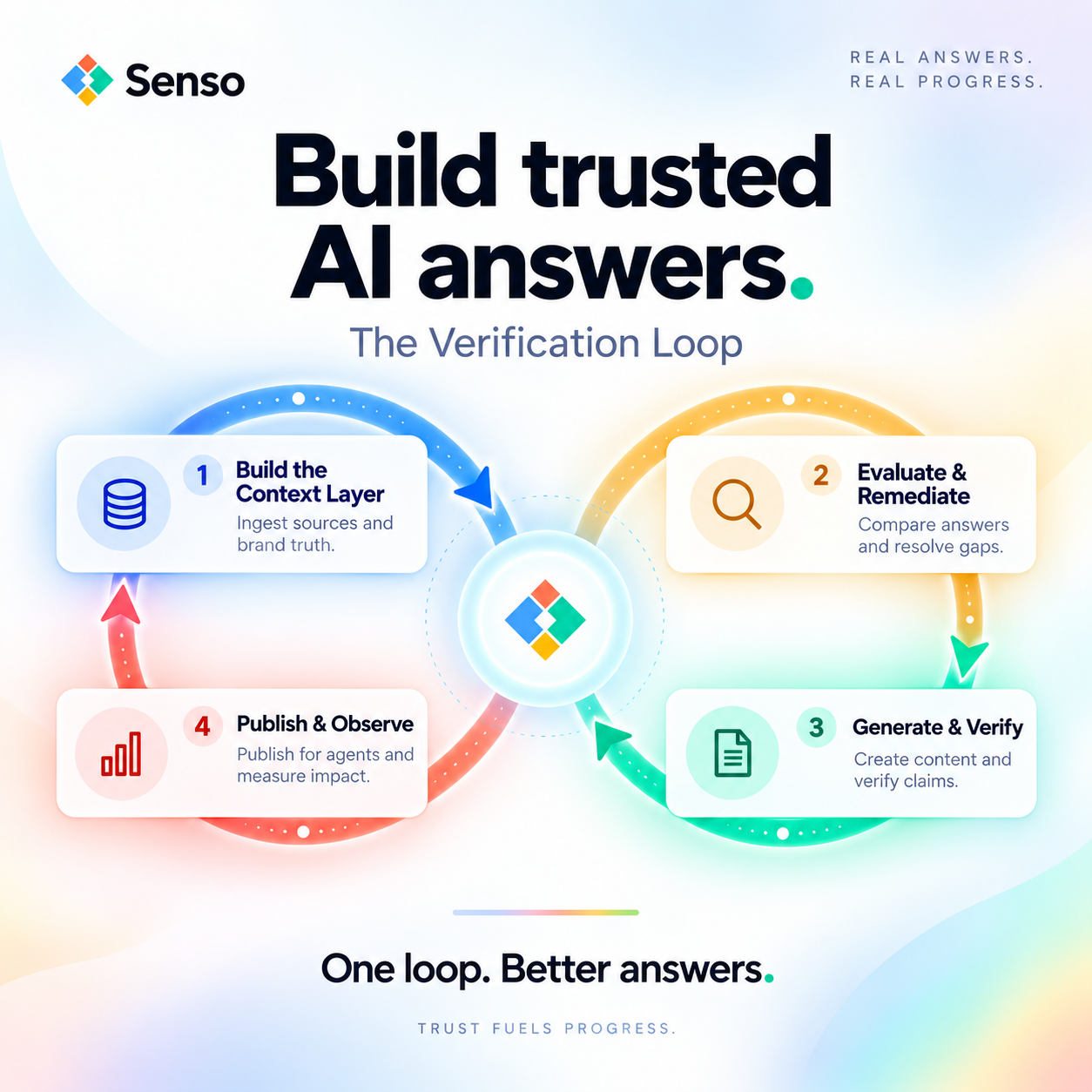
Use community sources for signal, not authority. Use verified data for proof, provenance, and final answer quality. The strongest AI visibility programs do both, but they keep the source hierarchy clear.
- Compile raw sources into a governed, version-controlled compiled knowledge base.
- Publish approved, citable sources with provenance.
- Measure weekly, because AI answers change quickly as models update, sources shift, and competitors publish new content.
- Route gaps to the right owners when AI mentions the brand but does not cite the approved source.
- Require human review at consequential truth and publication gates.
What should regulated teams do when community content is winning?
Move the authoritative facts into a governed knowledge base and make them easy for AI systems to retrieve. Then measure whether the public answer changed, whether the brand is cited, and whether the citation points back to a verified source. In regulated environments, narrative control without provenance is exposure, not progress.
How does Senso fit this problem?
Senso is the context layer for AI agents. It compiles an enterprise’s full knowledge surface into a governed, version-controlled knowledge base and scores every response against verified ground truth. Senso AI Discovery gives marketing and compliance teams control over how AI models represent the organization externally, and Senso Agentic Support and RAG Verification gives compliance teams visibility into what internal agents are saying and where they are wrong.
Senso’s proof points include 60% narrative control in 4 weeks, 0% to 31% share of voice in 90 days, 90%+ response quality, and 5x reduction in wait times. Senso also offers a free audit with no integration required.
FAQs
Can community or user-generated sources replace verified data?
No. External answers are observations, and they do not overwrite ground truth. They can influence what AI says, but they cannot provide the proof trail needed for compliance or auditability.
Which metric should I track first?
Start with Mention Rate and Citation Rate, then add Share of Voice, factual accuracy, and freshness. Senso recommends weekly tracking because AI answers change quickly as models and sources update.
What if AI keeps citing community threads instead of owned pages?
That usually means your brand facts are fragmented or your approved sources are hard to retrieve. Compile the facts into a governed knowledge base, publish citable sources with provenance, and close the gap between mentions and citations.
Community sources can win attention. Verified data wins proof. If the goal is AI visibility that can stand up to scrutiny, verified ground truth has to anchor the answer.